

Young New Yorkers Are Losing Money on Prediction Markets. That's Not a Reason To Ban Them.
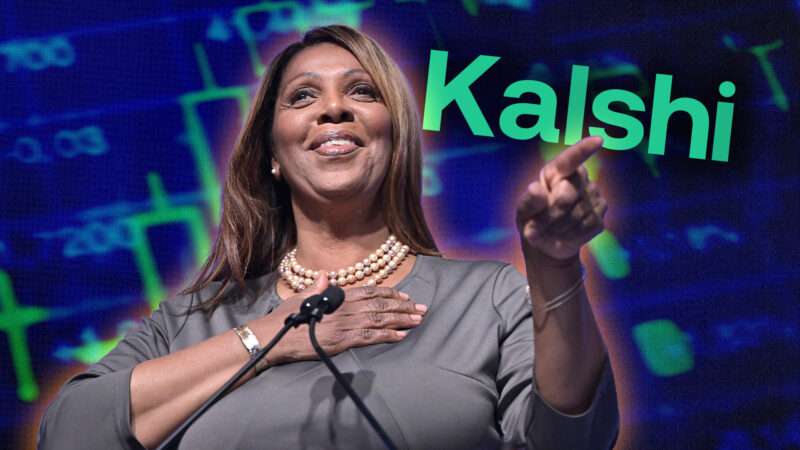
A New York City Council report released Tuesday found that users ages 18–20 accounted for about 17 percent of the $52.5 million the city's users lost on prediction markets between January and November. That's compared with institutional users—such as brokers, exchanges, and hedge funds—who gained over $340 million trading on prediction markets during the same time period.
This revelation hasn't sat well with council members, including Speaker Julie Menin, who on Tuesday accused prediction market platforms such as Kalshi and Polymarket of "targeting young people with deceptive, predatory marketing practices" that are "tragically" working. Menin said that because of the report's findings, the City Council would "hold a hearing to consider first-in-the-nation regulations" for prediction markets. She added that the council expects the executives of these platforms to testify.
Menin ignores the fact that institutional users are professional traders who likely have more experience with derivatives markets than the average under-21-year-old New Yorker. They also have better resources. In May, a University of San Diego study found that institutional users partly owe their success to a timing edge gained from trading with automated bots since retail traders tend to enter contract markets after prices have already adjusted and most of the value has disappeared.
Menin isn't the only New York government official going after prediction markets. On Monday, CNN reported that New York County Supreme Court Justice Melissa Crane denied Attorney General Letitia James' request for a temporary restraining order that would have prohibited Kalshi from operating in the state as James' legal battle against the company continues. During the hearing, Brent Tomer, the assistant attorney general for New York's Investor Protection Bureau, said that the state was not "seeking to shut down Kalshi entirely," according to Front Office Sports. Yet a restraining order would do exactly that, preventing the company from offering its services to the 1.5 million users in the state already trading on the platform.
Crane was unmoved by Tomer's argument that by allowing Kalshi to continue operating as an unlicensed gambling platform, New York wouldn't be able to collect on its gambling tax, which would seize over 50 percent of Kalshi's revenue. Rather than rule prematurely, Crane preferred to "wait and see" whether the U.S. Supreme Court would weigh in on who can regulate prediction markets, since its decision would bind her, Front Office Sports reported. However, Crane did find merit in New York's concerns about young adults ages 18–20 using prediction markets like Kalshi. The New York Times reported that she asked both parties to "discuss a way of safeguarding for that age group" by next week. Short of barring users within that age group from prediction markets, it's unclear that any safeguards would satisfy New York officials, who have repeatedly referred to these platforms as illegal gambling products.
Crane's decision to deny New York's request for a temporary restraining order is a small victory for prediction markets, which state regulators have increasingly scrutinized. On Tuesday, Utah Attorney General Derek Brown moved to dismiss the state's criminal case against Kalshi after the prediction platform agreed to block access to its site by geofencing the state. Brown said Kalshi also "committed to monitor for Utah-based IP addresses trying to reach its site."
(Kalshi is a supporter of Reason Foundation, the nonprofit that publishes Reason.)
At the federal level, the Commodity Futures Trading Commission (CFTC) is using its rulemaking authority to secure its jurisdiction over derivatives markets and exchanges, including prediction markets. On Monday, the CFTC published a final rule on data reporting for certain event contracts, replacing its previous "patchwork of non-action letters" with clear guidelines for markets and exchanges. The rule requires platforms to collect a host of personal information—including occupation and employer—of anyone trading a contract fully backed with collateral equal to the contract's maximum payout or loss.
Platforms must also collect the names of any guarantors or financial backers with at least a 10 percent stake. While the rule was still being finalized, Kalshi said that collecting the new trader data would require a compliance period of at least 12–18 months. The rule appears to favor incumbents, placing an undue burden on smaller platforms and potentially preventing them from offering fully collateralized contracts altogether.
The Office of Information and Regulatory Affairs—part of the White House budget office—is also reviewing a June CFTC rule proposal that draws clear regulatory lines for event contracts under the agency's jurisdiction. The proposal specifically targets contracts that are against the public interest and those involving gaming, such as sports event contracts. Under the proposed rule, the definition of gaming would include organized sports whose outcomes depend on skill, athletic ability, or luck. But sports event contracts would still fall under the agency's jurisdiction because the outcomes are verifiable and have broader implications than the game's result.
Of course, forcing prediction markets and the CFTC to hedge their bets against a tide of state regulators will only hurt American adults, who can decide for themselves whether it's in their financial interests to trade on these platforms.
The post Young New Yorkers Are Losing Money on Prediction Markets. That's Not a Reason To Ban Them. appeared first on Reason Magazine.
FIP XML/RSS/RDF Newsfeed Syndication https://freeinternetpress.com/rss.php
© 2026 FreeInternetPress.com
Free Internet Press is licensed under a Creative Commons Attribution 3.0 United States License. You may reuse or distribute original works on this site, with attribution per the above license. Any mirrored or quoted materials may be copyright their respective authors, publications, or outlets, as shown on their publication, indicated by the link in the news story. Such works are used under the fair use doctrine of United States copyright law. Should any materials be found overused or objectionable to the copyright holder, notification should be sent to [email protected], and the work will be removed and replaced with such notification.
Please email [email protected] with any questions.