

Why India Cannot Rise With Weak State Capacity
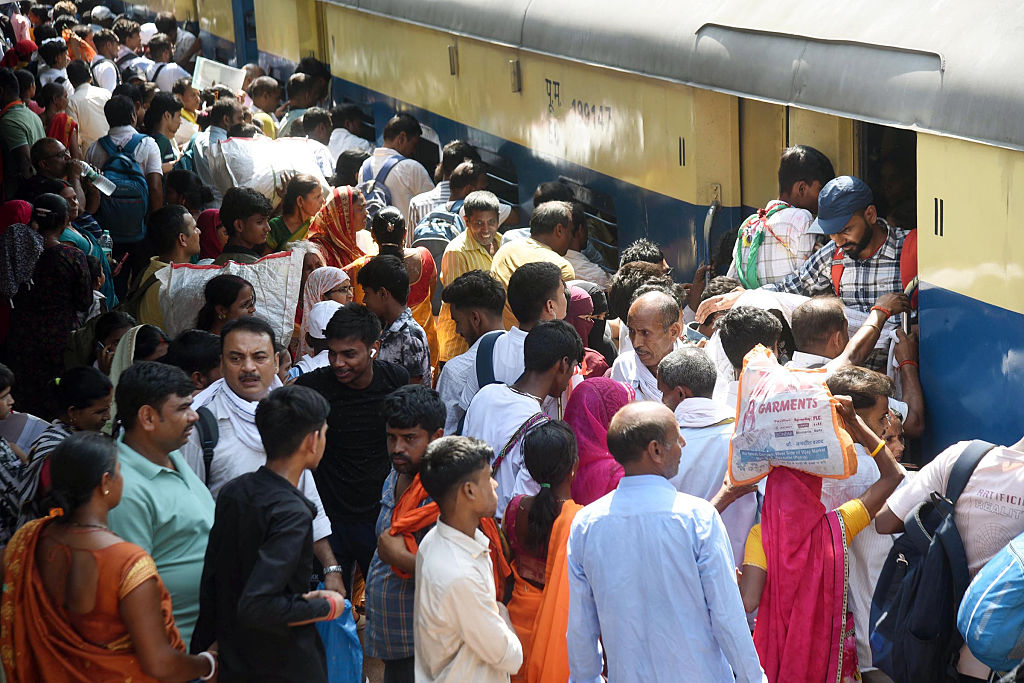
India faces a host of development challenges: education and health, manufacturing and jobs, urbanization and pollution. In the world’s most populous country, sheer scale makes addressing each of these daunting, and their convergence even more so. Climate change and artificial intelligence add more uncertainty, making many of these problems more acute in the next two decades. Yet none can be adequately addressed unless the principal actor shaping India’s development—the Indian state—becomes more competent.
The meta development challenge for India will face over the next few decades is the quality, competence and integrity of the state, without which progress elsewhere will remain elusive. Despite its multiple political and social divisions, India’s default ideology is statist: the governing Bharatiya Janata Party on the right, the communists on the left, and nearly everyone in between share a belief that the state should have a central role in controlling the economy and directing social change.
Why, then, is there so little effort devoted to improving how the state functions, even as challenges mount?
The trouble with an ineffectual state
In India’s vast federal system, responsibility for development is divided among different levels of government, each of which struggles to fulfil its obligations. Over the past decade, more than 1.5 million people, mostly of working age, have been killed in road accidents in India, at a fatality rate much higher than the global average (per distance traveled). Roughly one-third of the victims have been pedestrians, often killed because Indian cities fail to construct and maintain something as elementary as sidewalks.
The decrepit state of sidewalks exemplifies the depressing state of urban India. It reveals the extreme weakness of urban governance and the determination of state governments to retain control over lucrative urban land.
The private sector is the engine of economic development, but it runs on foundations supplied by the state ranging from law and order to health and education. While India has established a considerable degree of order, it flails on establishing the rule of law.
Violence has declined, but the police remain as much predators as protectors. Tens of millions of cases languish in overwhelmed courts, turning the legal process into principal punishment for all involved. If businesses cannot uphold contracts, women cannot walk safely after dark and minorities live with pernicious insecurity, the foundations of development will remain dangerously fragile.
India may not possess vast natural riches, but it has a cornucopia of people. Turning their potential into human capital would be an invaluable national asset, but the failures of the Indian state, especially its state governments, are nowhere more evident.
Indians live longer than they once did, but not necessarily healthier lives. High levels of malnutrition and stunting diminish the prospects of tens of millions of children. More children attend school but learning outcomes in public schools remain disheartening. Children do not vote; teachers do, and hiring teachers is a lucrative source of rent and political patronage.
The middle class, let alone the wealthy, would rarely consider sending its children to public schools, depriving the system of an influential constituency for reform. In higher education, where the federal government plays a larger role, ideological control and partisan appointments often take precedence over preparing young people for work, leaving millions with degrees that confer neither skills nor opportunity.
A checkered development odyssey
India’s checkered development odyssey has much to do with the ailments of the Indian state. Contrary to its overbearing image, the Indian state is relatively small when measured by the number of public employees per capita. And these public employees are frequently moved through the “transfer raj,” which has become another a source of rent for bureaucrats and politicians. Training is usually reserved for elite civil servants. In a generalist civil service overseen by politicians who prize loyalty over competence, expertise becomes an orphan.
These pathologies of the Indian state—a dense thicket of rules and procedures, extreme centralization and rigid hierarchy—are rooted in mistrust and an intensely status-conscious society. The result is an Indian state with the engine of a bullock cart and the brakes of a Rolls-Royce. In recent years, as India’s politics has grown more autocratic, centralization has become more acute within the federal government and in its relations with the states. Yet even as the federal government in New Delhi lords over the provinces, they do the same to local governments.
Unlike China and the United States, which employ many more people at the federal and local levels and fewer at the province level, India concentrates public employment in its states. This concentration of public employment and administrative control in the hands of state governments rather than local governments and municipal bodies has deprived India’s cities and towns of authority and agency.
All of this is widely known. Official reports have documented these failings for six decades. These pathologies persist because while everyone believes in the state and blames it the country’s afflictions, there is no impetus to build a stronger, more competent state.
The state provides immense rents to the political class and bureaucracy, while public employees form a powerful constituency against reform. Administrative reforms excite neither politicians nor intellectuals, and their rewards lie beyond the electoral cycle. A weak state is also easier to capture: politicians can use it to browbeat opponents and the ruling and business elites exploit it to extract rents.
This central development problem of weak state capacity is very unlikely to disappear by 2050. But India can augment capacity even without major administrative reforms. Technology offers the obvious opportunity. India has built a world class digital public infrastructure, which has improved taxation, public procurement and welfare payments.
But the very strengths of that system have also made transferring money to voters remarkably easy, encouraging competitive populism, even as efforts to strengthen core public goods have faltered. To invert the familiar adage, the Indian state prefers to offer citizens fish rather than teach them to fish, preserving their dependence on its largesse and, with it, their pliability as voters.
States can also improve their capabilities by drawing more effectively on civil society and business. Elinor Ostrom, the first woman to win the Nobel Prize in economics, observed that many public goods are “co-produced” by state and society. But such cooperation requires the state to trust civil society instead of seeking to control and muzzle it for political reasons, as is the case in India now. Contracting infrastructure construction or sanitation services to private companies can also help, though its benefits are limited by the persistent danger of rent extraction.
The condition of the Indian State offers little confidence that it recognizes the magnitude of the coming challenges and is gearing itself up to meet them. From the bureaucracy’s ability to formulate and implement policy predictably to the ability of courts, regulators and the Election Commission to enforce rules impartially, the core institutions of the Indian state are weakening.
This “strategic weakness” is not merely an accidental outcome of imperatives of electoral competition crowding out important long-term reforms. It is a deliberate choice by India's political class. Unless that choice changes, it is difficult to imagine India meeting its development goals in the next few decades.
FIP XML/RSS/RDF Newsfeed Syndication https://freeinternetpress.com/rss.php
© 2026 FreeInternetPress.com
Free Internet Press is licensed under a Creative Commons Attribution 3.0 United States License. You may reuse or distribute original works on this site, with attribution per the above license. Any mirrored or quoted materials may be copyright their respective authors, publications, or outlets, as shown on their publication, indicated by the link in the news story. Such works are used under the fair use doctrine of United States copyright law. Should any materials be found overused or objectionable to the copyright holder, notification should be sent to [email protected], and the work will be removed and replaced with such notification.
Please email [email protected] with any questions.