

Trump's FAA Moves To End the 50-Year Ban on Domestic Supersonic Flight
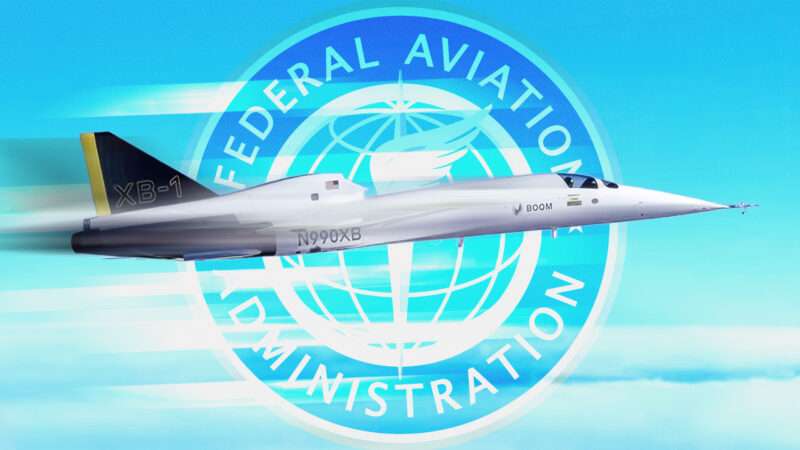
Supersonic flight was always focused on crossing oceans in record time. The Concorde famously brought flight times between New York and London down to three hours before its last retirement in 2003. But flying supersonic within the country has been off the table since the Federal Aviation Administration (FAA) banned overland supersonic flights in March 1973 due to loud sonic booms.
The Trump administration wants to change that—though the bureaucracy is moving slowly. Last year, President Donald Trump signed an executive order promising to "empower our engineers, entrepreneurs, and visionaries to deliver the next generation of air travel" by lifting the ban. Earlier this month, the FAA announced a proposal for new sound-based rules that would replace the total ban. Members of the public have until August 17 to comment.
The proposal sets a limit of 0.11 pounds per square foot of overpressure in the ground from sonic booms. (For comparison, the Concorde produced 1.94 pounds per square foot at peak overpressure.) The new limit is based on research by the startup Boom Supersonic, which is pioneering a technique to ensure that the shock waves from breaking the sound barrier bounce harmlessly around the atmosphere instead of reaching the ground.
Boom Supersonic itself is cautiously optimistic about the FAA's proposal. "We're thrilled that supersonic flight is about to be legal again, on the heels of our historic demonstration of boomless supersonic flight aboard XB-1," company spokeswoman Aubrey Scanlan tells Reason, promising to "provide our comments to the FAA after a full assessment" of the rules.
Supersonic passenger travel is a dream deferred by decades. In the 1960s, the working assumption of aircraft manufacturers around the world was that most long-haul flights would be supersonic. Airports, including the airfield in southern Florida that later became Alligator Alcatraz, were built to host the anticipated monster jets.
Sonic booms turned out to be more of a problem than expected. In 1964, the FAA and U.S. Air Force tried to prove the harmlessness of sonic booms by flying jets repeatedly over Oklahoma City. Instead, they ended up breaking windows, terrorizing citizens, and galvanizing a public backlash, leading to the FAA's ban on overland supersonic flights.
The other problem with supersonic travel was the economics. The only supersonic passenger jet that made it to market was the Concorde, heavily subsidized by the French and British governments. Even so, tickets were $7,000 per round trip—which would be nearly double in today's money. And a deadly accident in 2000 scared away many of the Concorde's customers.
Boom Supersonic is promising to solve both the economic and technical problems. It is the first private company ever to develop a supersonic airplane with (mostly) private money. CEO Black Scholl told CNN in 2021 that he was aiming at flights with $100 tickets, and after the flight of its XB-1 prototype in 2024, the company reported 130 orders and preorders from airlines.
As for sonic booms, the theories behind boomless supersonic flight have existed for a few decades. Only recently have aerodynamic computer models allowed engineers to put them into practice. An object flying faster than the speed of sound generates a cone of pressure waves that sounds like a loud explosion to anyone it passes over. Boom Supersonic attempts to take advantage of a phenomenon called Mach cutoff, in which refraction through the atmosphere prevents those pressure waves from ever hitting the ground. The company announced the first successful "boomless cruise" in February 2025, though scientists caution that Mach cutoff depends on specific weather conditions.
Whether or not this company specifically succeeds, it's important that the Trump administration is letting them try. And it's about time. A 2016 paper by the Mercatus Center at George Mason University argued that the current FAA regulations on sonic booms were not only lagging behind the state of aeronautical technology, but actually stifling further innovation.
"An affordable and commercially viable supersonic transport is unlikely to spring from the mind of a single engineer, much less a committee of bureaucrats. Like the subsonic aviation industry that came before it, a supersonic aviation industry will require trial and error, competition, and a market discovery process to lead firms up the learning curve to commercial viability," the paper states. "If we want rapid economic growth, we must continually question the limitations we impose upon ourselves and press forward the boundary of what is possible."
The post Trump's FAA Moves To End the 50-Year Ban on Domestic Supersonic Flight appeared first on Reason.com.
FIP XML/RSS/RDF Newsfeed Syndication https://freeinternetpress.com/rss.php
© 2026 FreeInternetPress.com
Free Internet Press is licensed under a Creative Commons Attribution 3.0 United States License. You may reuse or distribute original works on this site, with attribution per the above license. Any mirrored or quoted materials may be copyright their respective authors, publications, or outlets, as shown on their publication, indicated by the link in the news story. Such works are used under the fair use doctrine of United States copyright law. Should any materials be found overused or objectionable to the copyright holder, notification should be sent to [email protected], and the work will be removed and replaced with such notification.
Please email [email protected] with any questions.