
Trump Wants To Cover Up Bad News About the Iran War
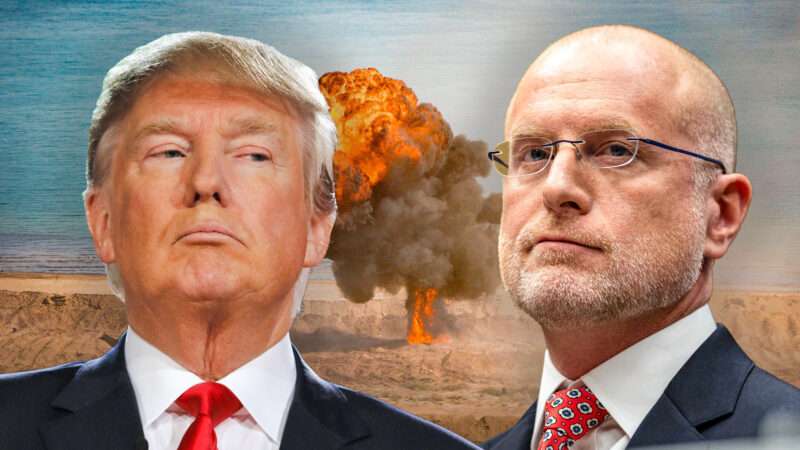
President Donald Trump believes that journalists "should be brought up on Charges for TREASON for the dissemination of false information." In a social media rant about his war on Iran, the president claimed that "Corrupt Media Outlets" were helping the Iranian government spread disinformation. He also highlighted a recent threat by Federal Communications Commission (FCC) Chair Brendan Carr to strip broadcasters of their licenses for sharing "fake news."
All this was inspired by a story that Trump himself admits is real. On Saturday, The Wall Street Journal reported that five U.S. Air Force refueling planes "were struck and damaged" on the grounds of a Saudi air base by an Iranian missile. "In actuality, the Base was hit a few days ago, but the planes were not 'struck' or 'destroyed.' Four of the five had virtually no damage, and are already back in service. One had slightly more damage, but will be in the air shortly," the president wrote. In other words: Trump acknowledged the report was true, and he took issue with something it didn't actually say.
Trump deemed the report fake news because it was bad news. And that attitude is shared by wartime U.S. partners across the Middle East. Authorities in Israel, the United Arab Emirates, Kuwait, Qatar, and Bahrain have between them arrested hundreds of people for sharing unauthorized footage of the war. (Iranian authorities have arrested around 500 people on similar charges.) Emirati authorities reportedly even arrested survivors of an Iranian drone strike who took pictures of the damage to their own building. Meanwhile, Bahraini prosecutors are seeking the death penalty on espionage charges for six people who "took photographs of locations where photography is prohibited."
The attempts to enforce the official line in these countries has created some absurd situations. On March 7, the Emirati authorities announced "a minor incident resulting from the fall of debris after an interception" near Dubai International Airport, even though video clearly shows a suicide drone successfully flying into the airport grounds and exploding. In an article about wartime censorship, the Israeli magazine +972 reported that "an Iranian missile hit its target while fragments struck a nearby educational facility. Yet the media was only allowed to report on the latter, without being able to even mention the former or inspect the damage."
The Trump administration has worked hand-in-hand with foreign censors to cover up bad news. On March 9, an explosion wounded 32 Bahraini civilians on Sitra Island. Viral video showed a missile taking off from a Bahraini air defense base near Sitra Island, veering off course, and hitting the ground. The Bahraini government claimed that all the injuries were caused by an "egregious Iranian drone attack." U.S. Central Command echoed the Bahraini official line, calling the reports of a missile misfire a "LIE" spread by Iranian and Russian media.
The U.S. government ultimately doesn't have the same power to punish dissent as its Middle Eastern partners. Trump's FCC, for example, has a history of threatening to revoke licenses. That may well have a chilling effect, but no licenses have yet been revoked, and such a process would take a long time.
And in some cases, aggressive investigative reporting has forced the administration to acknowledge reality. Reuters reported last week that 150 U.S. troops had been wounded in the war so far; at the time, the Trump administration was only acknowledging eight wounded. After that, the U.S. government updated its public count while insisting that most injuries were minor. Something similar happened with the reporting on the refuelling planes: It forced Trump to acknowledge the damage, even as he insisted the damage was minor.
Still, government pressure has succeeded at shaping coverage in subtle ways. Two satellite companies, Planet Labs and Vantor, have imposed a delay on selling imagery from the Middle East, which many journalists rely on to verify claims from both sides. Although both companies insisted that it was a voluntary decision, Planet Labs acknowledged that its decision was spurred by people "inside and outside of government." Vantor made a point of excluding Iranian territory from the restrictions, allowing journalists to verify U.S. damage to Iranian forces but not the other way around.
Several countries involved are sensitive to any negative reporting. Bahrain faces serious internal opposition, especially over the U.S. military presence. The United Arab Emirates is desperately trying to preserve its reputation as a safe haven for investors and tourists.
The Trump administration has taken a similar no-bad-news approach. Trump seems to believe that the economic damage caused by the war is simply a matter of jittery nerves, so he and his advisors have been trying to reassure markets that the danger will be over any minute now. Meanwhile, photojournalists were reportedly banned from the Pentagon for taking "unflattering" pictures of Defense Secretary Pete Hegseth.
On Friday, Hegseth complained to journalists that they were running "fake news" headlines such as "Mideast war intensifies" and "war widening." He suggested that "an actual patriotic press" would be reporting that Iran is "shrinking" and "increasingly desperate."
The harder the administration makes it to report on the facts of the war, the harder it is to know how the war is really going.
The post Trump Wants To Cover Up Bad News About the Iran War appeared first on Reason.com.
FIP XML/RSS/RDF Newsfeed Syndication https://freeinternetpress.com/rss.php
© 2026 FreeInternetPress.com
Free Internet Press is licensed under a Creative Commons Attribution 3.0 United States License. You may reuse or distribute original works on this site, with attribution per the above license. Any mirrored or quoted materials may be copyright their respective authors, publications, or outlets, as shown on their publication, indicated by the link in the news story. Such works are used under the fair use doctrine of United States copyright law. Should any materials be found overused or objectionable to the copyright holder, notification should be sent to [email protected], and the work will be removed and replaced with such notification.
Please email [email protected] with any questions.