

Trump Says His Task Force Is Fighting a Foreign 'Invasion.' It's Busting Americans for Drugs Instead.
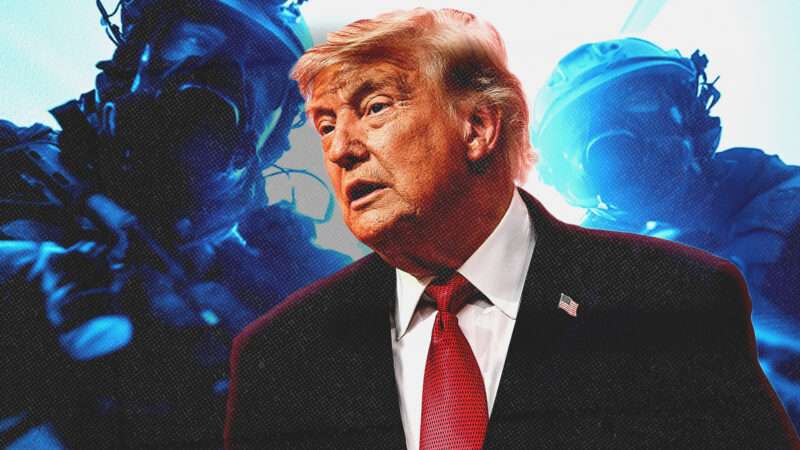
From the first day of Donald Trump's second presidential term, the administration has been offering a plan to protect the country from an invasion. Executive Order 14159, issued on the day of Trump's second inauguration, frames America as a country under siege by illegal immigrants, many of whom, it said, "present significant threats to national security and public safety, committing vile and heinous acts against innocent Americans." The invaders, the order insisted, intended to engage in "espionage, economic espionage, and preparations for terror-related activities."
To this end, the order instructed the Department of Homeland Security (DHS) and the attorney general to establish a new Homeland Security Task Force (HSTF) in every state.
Many federal task forces already existed—organizations where federal law enforcement agents work with state and local agencies toward a particular goal. The purpose of these new task forces would be "to end the presence of criminal cartels, foreign gangs, and transnational criminal organizations throughout the United States," the order said. The task forces would also work to "dismantle cross-border human smuggling and trafficking networks…with a particular focus on such offenses involving children, and ensure the use of all available law enforcement tools to faithfully execute the immigration laws of the United States."
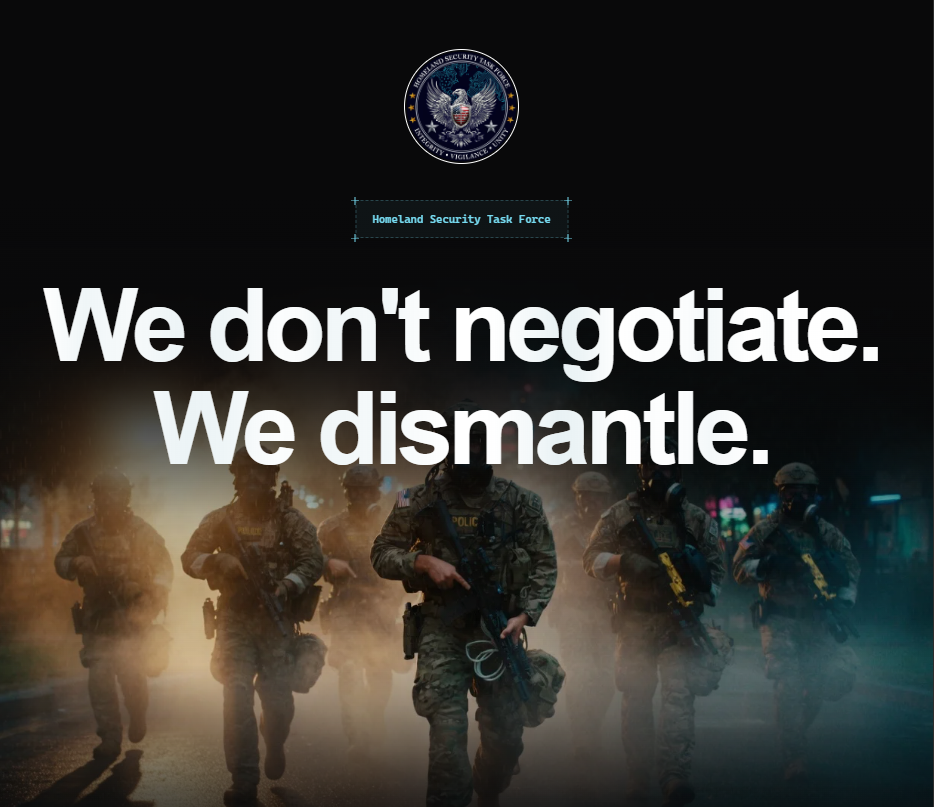
Since the task forces were launched late in August 2025, the messaging around them has hit the same themes as Trump's order. The top of the HSTF website says in big letters: "We don't negotiate. We dismantle." Below that, there is a picture of law enforcement officials looking like storm troopers, all decked out in army fatigues and riot gear and carrying big guns. Under the picture it says: "The threat doesn't respect borders. The response has to match it."
The new task forces "work congruently in one overwhelming force to eradicate threats and conduct criminal enforcement against transnational criminal organizations, including cartels, trafficking networks, and terrorist organizations," a DHS spokesperson told Reason in May.
They "integrate federal, state, and local law enforcement to focus targeted investigations on Foreign Terrorist Organization-designated drug cartels and transnational gangs," announced Jonathan Tapp, special agent in charge of the FBI New Orleans Field Office, in March. "Our mandate is clear: dismantle the [foreign terrorist organization]–designated cartels and transnational gangs root and branch," testified former acting director of ICE Todd M. Lyons in February. "Through unified partnership, we will continue to defend the homeland from evolving threats, safeguard critical infrastructure, and strengthen national resilience," declared FBI Assistant Director in Charge Christopher G. Raia in a December press release.
By spring 2026, evidence of their work started popping up everywhere. "This prosecution is part of the Homeland Security Task Force (HSTF) initiative established by Executive Order 14159, Protecting the American People Against Invasion," the Department of Justice would announce in press releases about criminals caught, convicted, and/or sentenced. "The HSTF is a whole-of-government partnership dedicated to eliminating criminal cartels, foreign gangs, transnational criminal organizations, and human smuggling and trafficking rings operating in the United States and abroad," as well as prosecuting and removing "the most violent criminal aliens."
In April 2026 alone, at least 30 of these announcements were posted to the Department of Justice (DOJ) website.
Laurance Newby was one such case.
In June 2025, Newby left his room in Lexington, Kentucky's Avid Hotel, put a bag in his Range Rover, grabbed a water bottle, and headed out for a walk on the Brighton East Rail Trail. When he finished his walk, police were waiting for him. A rookie drug dog named Bella had been "alerted to the odor of illegal drugs emanating from the vehicle," according to an affidavit from Christine McHugh, a special agent with the Drug Enforcement Administration (DEA). Asked in court later what justified setting the drug dog upon the car, McHugh said it was because they saw Newby "placing bags into his vehicle."
On three occasions, Newby had sold fentanyl to confidential informants in and around Lexington. After this, authorities had begun surveillance. Sometimes a DEA agent would run on a treadmill next to him at the gym.
Using Bella's sniff to justify a search of Newby's Range Rover, the cops—who had not obtained a warrant for the search—found nearly 1 kilogram of cocaine and around 440 grams of a fentanyl mixture inside. Newby was arrested and eventually accepted a plea deal. In April, he was sentenced to 15 years in prison.
"This prosecution is part of the Homeland Security Task Force (HSTF) initiative established by Executive Order 14159, Protecting the American People Against Invasion," the DOJ stated while announcing Newby's sentence.
Newby is a U.S. citizen, born and raised in Kentucky. Police arrested him in Kentucky. His sales to confidential informants took place in Kentucky. Nowhere in the DOJ's announcement, the criminal complaint against him, or his plea agreement do authorities suggest that he purchased drugs in a foreign country, smuggled drugs into this country, or left Kentucky at all in the course of his drug sales. Nor do they suggest that he was in cahoots with illegal immigrants, funneling money to foreign cartels, or doing anything that would seem to fall under the rubric laid out in executive order 14159.
So why was a task force dedicated to stopping an immigrant invasion going after him?
Looking at dozens of other task force prosecutions provides a clue. Under Trump, national security tools billed as fighting illegal immigration and human smuggling have been repurposed to fight the war on drugs.
"Any expansion of federal surveillance or federal authority or just budgets for federal law enforcement or state and local law enforcement always tends to land on drugs, because [drugs are] just always there and it's just the easiest thing," says Adam J. Smith, executive director of the Marijuana Policy Project. Drug cases are easy to make, and "the folks who are arrested, it's easy to vilify and it's easy for people not to care. These are drug dealers or drug users."
Despite their Trump-friendly immigration framing, the new Homeland Security task forces are simply following in the ignominious tradition of national security initiatives that wind up wielded to enforce drug prohibition.
The Patriot Act Shows Terrorism Laws Have Always Drifted Toward the Drug War
We saw something similar happen with the war on terror and the USA PATRIOT Act. That law authorized a lot of surveillance in the name of stopping terrorism, Smith notes, but "there just wasn't enough [terrorism], and so suddenly the surveillance expanded their scope and included drugs."
For instance, the PATRIOT Act, which President George W. Bush signed into law in October 2001, authorized sneak-and-peek searches, which let law enforcement execute search warrants and then not tell those affected for 30 days. Use of these warrants was initially rare: "Law enforcement made 47 sneak-and-peek searches nationwide from September 2001 to April 2003," notes the Electronic Frontier Foundation. But by the end of the decade, authorities were making thousands of delayed-notice warrant requests each year—largely for drug cases. In 2009–2013, less than 1 percent of sneak-and-peek searches each year involved terrorism-related cases. In contrast, more than 70 percent of sneak-and-peek searches each year involved narcotics cases.
This has a pattern that has held, even as the number of such warrants requested and granted has grown substantially. Between October 1, 2023, and September 30, 2024—the most recent period for which there is public data—some 17,475 sneak-and-peek warrants were requested, with 69 percent of these for drug investigations and 0.8 percent for terrorism investigations.
The PATRIOT Act also expanded the government's wiretapping authority. In 2009, 2,376 wiretap orders were issued; 2,046 of these were part of drug investigations, according to U.S. courts data. In 2024, the most recent year for which I could find data, courts authorized 2,297 wiretaps and the most serious offense in 49 percent of these investigations was a drug charge.
In Newby's case, authorities employed wiretapping and GPS tracking. Meet the new drug war, same as the old drug war.
Of the 30 task force cases announced by the DOJ in April, 25 involved drug charges. None involved human trafficking or human smuggling. (The five nondrug announcements concerned one illegal gambling operation in Missouri, one drive-by shooting involving an Atlanta gang, one case of bank larceny, and two cases of wire fraud involving Economic Injury Disaster Loans provided to fake businesses during the COVID-19 pandemic.)
Trump's 'Invasion' Task Force Is Mostly Arresting American Drug Dealers in American Cities
Only five out of the 30 press releases mentioned suspects being in the U.S. unlawfully. Much more common were suspects from such places as Johnstown, Pennsylvania, or Detroit, Michigan. These were busts of American drug dealers, dealing drugs in American cities. One need not agree with their actions to question whether their prosecution is the best use of Homeland Security resources.
Take David Winchell, a father of three from California. In May, Winchell—a U.S. citizen, born and raised in Indiana—was sentenced to seven years in prison for selling marijuana and marijuana-related products in his native state. His case was publicized as part of the HSTF initiative purportedly "protecting the American people against invasion."
Then there was Shontel Reshard Fedd, a U.S. citizen from Port St. Joe, Florida. He was on his way through Northwest Florida Beaches International Airport, coming back from California, when law enforcement searched his suitcase and found around 13 pounds of marijuana. Fedd was arrested, and in March he and a "co-conspirator" from Panama City, Florida, pleaded guilty to marijuana distribution. "This prosecution is part of the Homeland Security Task Force (HSTF) initiative established by Executive Order 14159, Protecting the American People Against Invasion," the Justice Department said.

In one HSTF case, a Massachusetts man who is a U.S. citizen with an infant daughter was convicted after bringing drugs across the border of Massachusetts into Maine. In another, some guy from Cedar Rapids, Iowa, sold meth to an informant. In another, a man from Cranston, Rhode Island, sold ketamine to an undercover cop. In another, two women in Sioux Falls, Iowa, were sentenced for selling meth brought in from California.
Since the Homeland Security Task Forces were created, there have been two big "surge" operations yielding splashy announcements and significant arrest numbers. After the first big surge, federal officials claimed to have "arrested more than 3,200 foreign terrorists, narcotraffickers, and gangbangers…between August 25 and October 7 alone." After a January "human trafficking surge," 500 people were arrested on a mix of federal and state charges. In both instances, authorities provided few details to back up their big claims.
"In fiscal year 2026 alone, more than 3,770 members of TCOs [transnational criminal organizations], FTOs [foreign terrorist organizations], gangs, and other criminals have been arrested," a DHS spokesperson told Reason.
The words "and other criminals" seem to be doing a lot of work in that sentence.
In case after case bearing the mark of Executive Order 14159, prosecutions seem aimed at localized and relatively small-scale teams of drug trafficking Americans.
Just seven out of the 30 Homeland Security Task Force announcements in April 2026 mention a possible cross-border element. Only three of these mention potential ties to a transnational criminal organization or foreign gang.
In total, the 30 press releases from April name 88 suspects being prosecuted as part of the Trump administration's efforts to protect us from invasion. Only 13 of the suspects are described as being unlawful immigrants.
Sixty eight of the 88 suspects appear to be U.S. citizens. Three suspects seem to be non-citizen immigrants who were in the country legally, three are of unclear status, and one was a Colombian man residing in Colombia but extradited to the United States.
Trump Gave the Old Drug War a New Name—and Took Credit for Biden-Era Cases
With its rhetoric about illegal immigrants and invasion, this effort to dress up domestic drug crimes in national security pretenses is geared to the obsessions of the Trump-friendly right. But it follows an old playbook.
Drug warriors can always justify their actions by saying they're looking for international criminal cartels, explains Smith. "It doesn't matter what [the drug] is or where it actually comes from, and they don't have to show that. It's just a trope. If it's drugs, it's international cartels. It could be being made in a lab in Colorado, who knows?"
The Homeland Security Task Force drug cases don't seem to represent a ramping up of the drug war so much as a MAGA-friendly rebranding. In January 2026, prosecutions referred by the DEA were actually down substantially from 2021, according to the Transactional Records Access Clearinghouse at Syracuse University. Overall federal drug prosecutions (referred by any agency) were also down substantially.
But even if prosecution numbers are down, there are still a lot of drug prosecutions happening. Many are being framed as a new, unprecedented attempt to tackle international gangs and immigrant crime.
This comes despite the fact that many of the cases now being publicized as being part of the HSTF initiative were begun long before the creation of these task forces.
In one case involving a Louisiana man sentenced to 15 years in prison for offenses involving cocaine and heroin, federal agents began investigating in 2017. In another drug case, involving a Fordyce, Arkansas, man sentenced to 10 years in prison for possession with intent to distribute meth and cocaine, the investigation began in February 2024.
Of those 30 April cases, 21 have roots in the Biden administration. Only six were initiated since Trump took office in 2025, and only four since the HSTFs launched.
These are the kinds of cases previously prosecuted by the Organized Crime Drug Enforcement Task Force (OCDETF), an initiative established under President Ronald Reagan in 1982. "OCDETF is the centerpiece of the Attorney General's strategy to combat transnational-organized crime and to reduce the availability of illicit narcotics in the nation," its website stated.
The Trump administration dismantled OCDETF last summer, transferring much of its authority and funding over to the new Homeland Security Task Forces.
"According to the Department of Justice, as of September 30, 2025, OCDETF has been shut down and its functions have been transferred to the new Homeland Security Task Forces," said the Government Accountability Office in a December report.
Same general idea, but this time, Homeland Security—not the Department of Justice—is in charge.
The Task Force Is Manufacturing Conspiracy Charges for Harsher Penalties
Despite the new gloss about protecting Americans from immigrant threats, the cases being prosecuted by the Homeland Security Task Forces seem exactly like the kinds of cases that OCDETF handled.
Many HSTF cases involved conspiracy charges, with prosecutors alleging that two or more people were working together in an attempt to procure and sell drugs. Of the 30 task force cases announced by DOJ in April, only two did not involve conspiracy charges.
Alleging conspiracy is a common drug war tactic. "Basically anytime they can tie two people together, they're going to bring it into one conspiracy case," says Smith. Prosecutors are "going to pull everyone into a conspiracy based on whatever connection they can find and then let the court sort it out because it's just better for them."
Drug-trafficking conspiracy charges don't require someone to actually be caught in the act of handling or selling drugs; authorities must only prove that there was an agreement between two or more people to try and do so. There's no need for cops to witness drugs and cash exchanging hands. Prosecuting someone as part of a conspiracy puts them on the hook for the whole group's actions, not just whatever (possibly quite small) part they played in these actions. A conspiracy charge can carry a much higher penalty than a drug possession or drug distribution charge alone.
This possibility of steeper penalties may incentivize defendants to take plea deals—and turn against others they know—rather than chance it at trial.
Besides, announcing the bust of a drug "conspiracy" or "gang" may look better for law enforcement than simply announcing scattered drug arrests—and it can help bring in more money, too. Police are judged on arrest numbers, notes Smith. "It justifies budgets."
It may also let officials inflate the scope of the "siege by illegal immigrants" that America is supposedly facing. Slap boilerplate language about protecting America from invasion on statements about domestic drug cases, and people are likely to assume the two are related.
"There's just so much incentive to expand everything into drugs because it justifies everything," Smith says. "It justifies the surveillance; it justifies the law enforcement spending; it justifies the prison spending."
It's a dystopian feedback loop: "National security" justifies the war on drugs—and the war on drugs, with its easy and plentiful arrests, justifies more funding and power for those claiming to promote national security. The Trump-era twist is the pretense that domestic drug war prosecutions confirm the president's dire warnings about a criminal alien invasion—and a fulfillment of his promise to protect Americans from the invaders.
Who Is Trump's Homeland Security Task Force Arresting?
Reason reviewed 30 arrest announcements published by the Department of Justice in April 2026 as part of the Homeland Security Task Force. Of 88 suspects, the review found 70 who appear to be U.S. citizens. Most cases also did not have a connection to border crossing or illegal aliens.
*Six of the eight appear to have been in the U.S. illegally
The post Trump Says His Task Force Is Fighting a Foreign 'Invasion.' It's Busting Americans for Drugs Instead. appeared first on Reason.com.
FIP XML/RSS/RDF Newsfeed Syndication https://freeinternetpress.com/rss.php
© 2026 FreeInternetPress.com
Free Internet Press is licensed under a Creative Commons Attribution 3.0 United States License. You may reuse or distribute original works on this site, with attribution per the above license. Any mirrored or quoted materials may be copyright their respective authors, publications, or outlets, as shown on their publication, indicated by the link in the news story. Such works are used under the fair use doctrine of United States copyright law. Should any materials be found overused or objectionable to the copyright holder, notification should be sent to [email protected], and the work will be removed and replaced with such notification.
Please email [email protected] with any questions.