

The Iran War Is Over, For Now
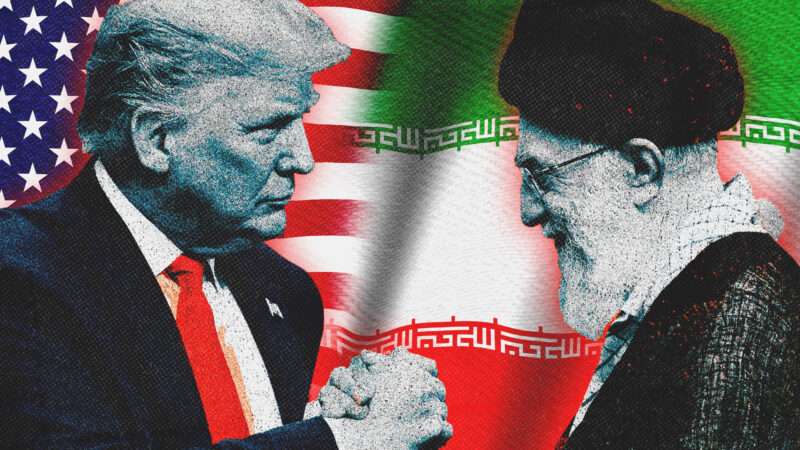
There have been so many claims about the Iran War ending that it's hard to believe this one. After the April ceasefire, the United States and Iran repeatedly claimed that a full peace deal was around the corner, only to continue firing in hopes of better terms. But that cycle might actually be over for real now.
U.S. President Donald Trump, the Supreme National Security Council of Iran, and Pakistani Prime Minister Shehbaz Sharif (who was mediating) all confirmed on Sunday night that the parties had agreed to a memorandum of understanding to move forward with the peace process. The U.S. will immediately lift its blockade of Iranian ports, Iran will begin clearing mines from the Strait of Hormuz, and, after a signing ceremony on Friday, the countries will begin negotiations for a permanent peace deal.
This comes just in time to avert a serious economic crisis. The oil tanks in Cushing, Oklahoma, a hub for the American oil trade, were visibly emptying out last week. Iran's own oil production has fallen to its lowest level since the coronavirus pandemic. "Ships of the World, start your engines. Let the oil flow!" declared Trump on Truth Social. Shipping industry associations say it will take some time to return to normal.
Although the full text of the truce isn't public yet, the broad outline has been confirmed by both sides. The U.S. will issue Iran a 60-day waiver to the U.S. embargo on oil exports, and Iran will suspend its toll on passing Hormuz for 60 days. By the end of the truce period, the negotiations are supposed to produce a solution to the Iranian nuclear program, the future management of Hormuz, and the U.S. economic sanctions on Iran.
In other words, Trump's offer is a lot like former President Barack Obama's offer. Iran can trade away its nuclear capabilities in exchange for integration into the world economy. Ali Ahmadi, a researcher in Turkey, compares the current truce to Obama's 2013 interim agreement that paved the way for the full 2015 deal.
There is, of course, an important difference: Obama's outreach was meant to avoid the threat of war, while Trump's diplomacy is meant to get out of a war that he started.
The set of guarantors has also changed. Obama's deal was designed as a global arrangement that included Russia, China, and Europe. Trump's deal is being negotiated with the help of Iran's neighbors. Qatar, Egypt, Saudi Arabia, and Turkey all assisted Pakistan with the mediation, according to U.N. Secretary General Antonio Guterres. Last week, the United Arab Emirates reportedly unfroze Iranian money held in Emirati banks as a goodwill gesture, although the Emirati government denies these reports.
"This Great Deal will bring Peace and Security to the whole Region. Many presidents have tried to make Peace with Iran, and all have failed before me. The Leaders of the Region have, for the first time, found a President who can help them achieve real Peace," Trump claimed on Truth Social.
It's not clear what happens if the 60-day negotiating period expires without a final peace treaty, although nothing is stopping the two sides from extending their truce. If the past three months are any indication, both sides will keep trying to test each other's limits as part of the negotiating process. The point of this week's memorandum is to keep those tests below the level of war.
The most explosive point of disagreement seems to be Lebanon, where the Israeli army is fighting the pro-Iran militia Hezbollah. Iran has been insisting that a ceasefire should also include Lebanon, and is threatening to bomb Israel in response to any Israeli moves on Beirut, the Lebanese capital. On Sunday, after Hezbollah flew drones into northern Israel, the Israeli army bombed Beirut, killing three people.
Iran got ready "to launch a large number of missiles at the Israelis" but called off the attack under U.S. pressure, U.S. Vice President J.D. Vance told Fox News on Sunday night. An Iranian source told Amwaj.media that Trump had offered to accelerate the timeline for lifting the blockade if Iran did not attack. Trump also publicly demanded "no more attacks by Israel anywhere in Lebanon" and privately asked Israel to withdraw from Lebanon, according to Israel's Channel 12.
Israeli Defense Minister Israel Katz declared on Monday that the army will stay in Lebanon "without any time limit" and clear out the Lebanese population from the areas it holds. "Prime Minister [Benjamin] Netanyahu made these points clear to U.S. President Trump and to other senior American officials, and I also made this clear yesterday to U.S. Secretary of War Pete Hegseth," he said, adding that "if Iran attacks Israel because of events in Lebanon, we will strike it with full force."
Domestic American hawks have also been trying to stop the peace process. Sunday night, Fox News host Mark Levin brought on former Trump administration official Nathan Sales and Sen. John Fetterman (D–Pa.) to discuss the ceasefire. "Israel will not be able to adhere to what would be a suicide pact," said Levin, who had personally advised Trump to attack Iran. In addition to Levin's complaints about tying Israel's hands, Levin and Sales warned that the peace deal doesn't disarm the Iranian military of its missiles.
Some critics of Trump who ostensibly opposed the war have adopted the hawks' line of attack against the peace. "Trump Celebrates While America Capitulates," read the headline in The Atlantic. Sen. Jack Reed (D–R.I.) complained that the U.S. "getting basically less than what we had" under Obama's deal, and Rep. Seth Moulton (D–Mass.) called the memorandum "basically a surrender document from Donald Trump to the supreme leader of Iran."
Iran's own hawks hate the deal too. A right-wing Iranian member of parliament, Mahmoud Nabavian, called the deal a "total loss" and said that "Iran will become a colony of the United States" under the memorandum. The crowd at a pro-government rally in Iran over the weekend shouted "death to the compromiser" and called on Foreign Minister Abbas Araghchi to resign.
In an apparent attempt to embarrass the negotiators last week, Iran's Mehr News Agency leaked what it claimed was a copy of the memorandum of understanding about to be signed. The report asserted that Iran would get up-front sanctions relief and even U.S. reparations without having to give up control of Hormuz. After domestic American critics piled on, Trump lashed out at Mehr's "dishonorable" claim. Araghchi publicly asked the media to "refrain from entering speculation," and Trump claimed that Iran had privately "apologized for putting out false information."
The drama of the last few days is likely to repeat itself over the next few months. The governments will downplay their own obligations while trying to muscle as much as they can from the other side. Sometimes they will offer honeyed words, and sometimes they will threaten to storm out. Domestic critics will shout that traitors are selling out the country. Contradictory rumors will float around. But at least for now, it will be a war of words, not bombs.
The post The Iran War Is Over, For Now appeared first on Reason.com.
FIP XML/RSS/RDF Newsfeed Syndication https://freeinternetpress.com/rss.php
© 2026 FreeInternetPress.com
Free Internet Press is licensed under a Creative Commons Attribution 3.0 United States License. You may reuse or distribute original works on this site, with attribution per the above license. Any mirrored or quoted materials may be copyright their respective authors, publications, or outlets, as shown on their publication, indicated by the link in the news story. Such works are used under the fair use doctrine of United States copyright law. Should any materials be found overused or objectionable to the copyright holder, notification should be sent to [email protected], and the work will be removed and replaced with such notification.
Please email [email protected] with any questions.