
The End of Social Media
I joined Facebook in 2004, Twitter in 2007, and Instagram in 2012—and I loved them. Really loved them. Especially Twitter. There was a time where my interior monologue happened in tweets.
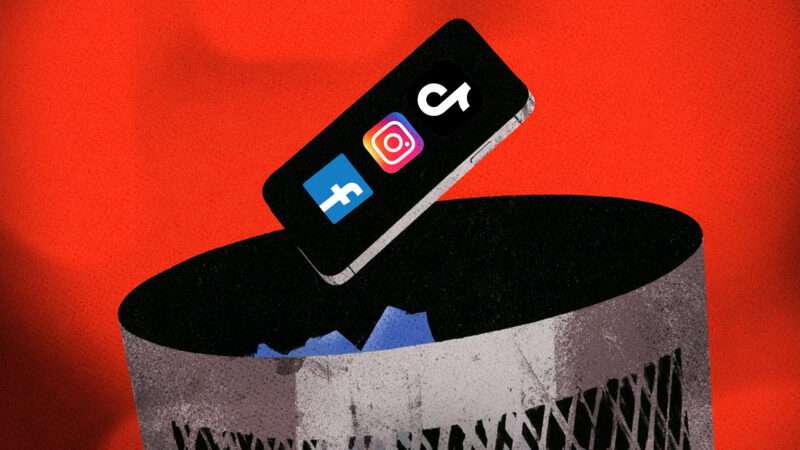
No one is sadder than me to say it, but social media is over. Dead. Done.
Those platforms still exist. So do newer contenders. But they bear little resemblance to the mediums I fell in love with.
In Reason's latest print issue, I've got a long piece that attempts to grapple with why and how this tragedy—yes, I'm calling it that unironically—happened. (Come for the pointing fingers at politicians, stay for my personal connection to AOC dancing on a rooftop!) It could have been a much longer article. To keep it tight, we focused mainly on political factors that have hastened social media's decline.
But there's a lot more to this story. So I'm going to use today's newsletter to wax a little nostalgic, flesh out a few more theories, and share some fun commentary from others that didn't make it into the final piece.
How it Started…
First: the nostalgia—a little for nostalgia's sake, a little because understanding what we lost requires understanding what we had. And what we had felt, for a while, fun and friendly and magical. Remember?
A little scene setting, courtesy of the print piece:
When AOC, my friends, and everyone else made these videos, no one was monetizing this content. The point was simply participation. The goal was to have fun. We were young, and so was social media.
A lot of early social media was like that. Cheesy. Collaborative. Pointless. People posted pictures of themselves "planking"—lying face down in weird locales, like the kitchen counter—just to be a part of a trend. They dumped ice water on their own heads and posted it, allegedly for Lou Gehrig's disease awareness but mostly just because it was the thing to do. They posted old photos on #ThrowbackThursday, lists of accounts they liked on #FollowFriday, and the results of whatever BuzzFeed personality quiz was new that week.
There were wedding, party, and conference hashtags, so everyone at an event, or following along online, could catch all the pictures and updates. If you ran into friends, made new friends, or just saw someone you vaguely knew at an event, you absolutely had to take and post a selfie.
We tweeted about where we were going out, and "checked in" to coffee shops on Foursquare. We made surveillance so easy, and we were too caught up in the hype of constant communication to care.
We were all in a big poly-parasocial relationship with one another, but the lines felt blurrier. It wasn't that weird for online friendships to eventually spill over into real life. And it wasn't weird to know—and genuinely care—about the lives of the people you interacted with online. (Perhaps the key to that sentence is "interacted." Social media was a much less passive medium then, and the parasocial-to-just-social bridge gets much shorter when you're mutually interacting day in and out.)
Before it became a platform for fighting, Twitter was a platform "where you had conversations with people and tried out ideas," says Ben Smith—lately of Semafor but once editor-in-chief of that bastion of the old internet, Buzzfeed News. People turned away from it and many of the old-school platforms "because they became toxic and horrible. But also, remember how nice they were?" he asks. "Like, I feel like I know you and we're total strangers. I used to really enjoy your tweets, and you would DM me once in a while and be like, 'great story!' or whatever. And I made a lot of really good friends on there, and it felt like all those interactions were real."
Smith also shared this tidbit, which I must pass on because it's such a perfect distillation of the kind of things that happened on the early-21st-century internet: His Buzzfeed colleague Ze Frank, a vlogger, would encourage people to make an "earth sandwich" by finding "someone who lived in the exact antipode of where you lived and each put a piece of white bread on the ground at the same time."
Absurd and pointless? Yes. But also centered around connection. With the social web, we had these radical new ways of connecting, and we were testing their use cases, feeling out the parameters, figuring out by trial and error what they might be good for.
Big Mood
It's tempting to conflate that era of the internet with particular platforms. But it was also an ethos—of optimism, silliness, possibility—combined with an astounding acceptance of the idea that social media was and forever would be our new normal.
In its early years, social media felt omnipresent and etiquette around it emerged to favor that feeling. ("I think the way that we interacted with social media, once upon a time, was a quintessentially Millennial experience," says author and Substacker Freddie DeBoer.)
If you met someone new in person—at a party, at a work event, at school, wherever—the thing to do was to friend them afterward on Facebook, Twitter, or Instagram. If you were planning an event, of course the easiest way to let people know was with a Facebook invite. If you had big news, of course you announced it there.
As a result, it felt like you had to be on these platforms. If you wanted to keep in touch with old friends, build relationships with new friends, get invited to parties, see family members' photos, promote your art or work or school fundraiser, participate in a cause, anything—you had to be there.
Smith suggests that for those of us in or approaching middle age, falling out of love with the old platforms might just be part of the natural life cycle of hangouts:
I actually think to some degree [social platforms] come and go in the same way that restaurants and clubs come and go. Like why is a club popular, why do you like going to a bar? Well, it's because your friends are there. And then why do you stop going? Your friends aren't there anymore.
And if they fix the sound system or the lighting or, like, they make the beer better—it doesn't matter. And you're not going to the same bar when you're 30 as when you were 20. And there's not really any way to fix that.
I think a lot of this stuff is, like, these are social institutions that come and go. YouTube is the only one that has turned itself into infrastructure for everyone.
I think there's something to that, for sure. But also, at one point, all social media felt like infrastructure. What happened?
…How It's Going
In the early days of the social web, that "everyone you know and everything you care about is here" feeling was combined with a lack of algorithmic curation. Our feeds were just chronological lists of things shared by our friends or the brands and bands and groups and media we followed. Things were less exciting, in some ways, but also more customizable and controllable.
The introduction of algorithmic feeds changed things greatly. Rather than logging in and perhaps seeing up top a picture of your friend's children, someone's Farmville game results, a link to the latest Buzzfeed personality quiz, or a benign comment about whatever TV show was trending, you were likely to see something more captivating, more infuriating, more engaging. And for a while, this seemed to make social media even more compelling.
Look, I once wrote a whole feature called "In Defense of Algorithms." I don't think algorithms are to blame for anything near the chaos and calamity they get blamed for. But I do think the switch to algorithmically selected content may have started something that the TikTok-ification of everything would later turbocharge, and that this ironically would ultimately weaken people's ties to social media. The platforms shot themselves in the foot.
The algorithms—combined with politicians pushing platforms away from news/politics/journalism content, as I noted in my longer piece—certainly aided professional influencers in gaining ground.
In the early days of social media, no one spoke of "curation" or "content strategy." The idea—in theory, if not always in practice—was just to share what you were doing or thinking right then. (Or, if you were a professional or aspiring writer or commentator, to share enticements to things you had written and posted elsewhere.) Posting simply didn't require a lot of thought, and whether your friends and followers would see your posts depended only on when they logged in. But in an algorithm-driven universe, the most "engaging" content (as determined by likes and comments) and the creators who strive for this rise to the top.
Influencer culture changed the way people think about posting. Gone are the days where one would throw a bunch of unedited vacation pics in a Facebook album, post a random happy hour pic to Instagram, or upload to YouTube a single-camera shot of a long conference panel.
Influencer posting is "very strategic" and "very thought out," says tech journalist Taylor Lorenz, who writes the UserMag newsletter on Substack. "It used to just be fun to share things." But now, "because it's such a hyper intense attention economy" and "platforms are moving towards [being] more like entertainment, consumption based platforms," people feel insecure about sharing content that doesn't feel highly produced. "You feel this pressure to make it look good…the production value for everything is up so much."
Then TikTok started outpacing other platforms in the attention economy, and other platforms—namely Facebook and Instagram—started trying to be more like TikTok, prioritizing short-form video content and pushing more and more of it into everyone's feeds whether they followed folks sharing these videos or not.
Some No Personal News
The ascendancy of short-form video was the biggest counterpoint people gave me to the idea that social media was dying. "I think it would be a mistake to overgeneralize from 'stuff that looks and functions very much like Twitter is becoming less popular & relevant' to 'social media is dying,'" says Julian Sanchez, who writes the newsletter Non-Content on Substack (and long ago was a staffer at Reason).
In judging whether social media is over, "I think the only question that really matters is whether shortform video counts as social media," says DeBoer. "If it does, then obviously the era isn't over."
And yet… "Instagram Reels and TikToks serve very different purposes than Facebook and Twitter once did," DeBoer adds. "I think people mean something very different when they're talking about social media."
I do too. And I think the pivot to short-form video—which is very much not the kind of thing that just everyone can get in on—may actually have helped kill social media, or be on its way to doing so. With the TikTok-ificaiton of everything, the effort it takes to post goes up (a video is a whole different beast than a bit of text or a still photo) and the impetus to post rather than simply consume content goes down. More and more of our feeds are filled not with our friends, or even with celebrities and culture-makers we followed, but with random videos of random people that some algorithms determines we might watch.
Again, this is clearly meant to make social platforms more engaging—and certainly on some level and for some people, it does. But engagement-driving algorithms combined with the "everything is television" version of social media that we know now may also be making it easier for people to cut down on or quit social platforms altogether.
"Network effects"—a fancy way of saying that there are benefits to everyone you know or everyone you want to interact with being in one place or using the same product—helped pin people to legacy platforms like X/Twitter and Facebook. But as our feeds started being inundated with influencer posts and then all manner of short-form videos produced by total strangers, we started seeing less and less of the people who brought us to these platforms in the first place and made it feel crucial to be on them.
It's not so hard to leave Facebook or Instagram when what you're seeing there is largely content created by people you neither know nor have ever even heard of, along with ample ads and some AI slop. It's not so hard to leave when you're no longer connecting and conversing, or even fighting, but just consuming.
When people are down on the internet, they used to talk about "getting into these nasty online arguments," whereas now they talk about "doom-scrolling," points out Katherine Dee of Default.Blog. "They're not even really invested in what they're consuming on their phone, it's just kind of something to do."
"I'm one of the rare people who thinks that [short-form video] doesn't really rot your brain," she adds. (Me too!) But watching short-form videos is something you might do in the way you once sort of just had the TV on in the background, she suggests. It's closer to that then to the way we used to use social media. Social media of yore "was often cheesy, but it was participatory," Dee points out. "You felt like you were all joining in and doing something together. And I think that feeling is very, very over."
The more passive use of "social" media like TikTok videos, Instagram Reels, and YouTube shorts may not be a herald of doom or even a new phenomenon—more like a return to baseline. It brings us closer to the media/news consumption habits of millennials' parents and grandparents than the anomalous years of the millennial internet, of peak Twitter and Facebook, of Buzzfeed quizzes and "gram-worthy" backdrops, pile-ons and participatory memes.
Putting down our phones in those years could be difficult, and certainly harder than changing the channel or pressing off while half-hardheartedly flipping through TV stations. But as social media has gets more like TV—passive, filled with strangers—it also gets easier and easier to walk away.
More Sex & Tech
A.I. right now reminds me of the late-'90s internet. There's a ton of hype around projects that hardly any consumers seem to want; you have to tune that out and figure out what uses ordinary people are finding for it.
— Jesse Walker (@notjessewalker) October 4, 2026
• A Wall Street Journal op-ed blaming porn for gang rape claims "most online porn videos contain depictions of some kind of physical violence." The linked study surveyed the best-selling and most-rented porn videos from late 2004 and early 2005. (And the "violence" here includes spanking.)
• How Rand Paul killed KOSA (for now, at least).
• The lesbian-tinged campaign ad dividing conservatives.
• Anthropic stop-talking-about-Claude-as-if-it's-human challenge.
• Is using artificial intelligence to help you talk to federal agents prohibited now?
STOPPED AT THE PORT
Washington Dulles
A traveler used AI to prepare for CBP questioning and apparently got one more tip: destroy the evidence.
Officers found the shredded instructions and put them back together piece by piece.
The plan meant to get them in helped send them home instead.
#OFOproud
— Executive Asst. Commissioner Diane J. Sabatino (@OFOEAC) October 1, 2026

• Every time a politician even slightly leans toward supporting sex work decriminalization, some opponent will trot out sex-trafficking survivors like show ponies and pretend that letting consenting adults sell sexual services is the same thing as letting women be forced into prostitution.
• "U.S. Customs and Border Protection (CBP) searched 47,047 electronic devices (phones, cameras, laptops, etc.) at U.S. ports of entry (POE), detaining 2,316 devices for further investigation in fiscal year 2024," per the Department of Homeland Security's Office of the Inspector General. "However, CBP did not properly document device searches or track key…metrics related to extracted information."
• Eric Boehm asked the White House's new AI chatbot about tariffs, and the bot did not stick to Trump's script.
• It's always "antitrust."
The post The End of Social Media appeared first on Reason Magazine.
FIP XML/RSS/RDF Newsfeed Syndication https://freeinternetpress.com/rss.php
© 2026 FreeInternetPress.com
Free Internet Press is licensed under a Creative Commons Attribution 3.0 United States License. You may reuse or distribute original works on this site, with attribution per the above license. Any mirrored or quoted materials may be copyright their respective authors, publications, or outlets, as shown on their publication, indicated by the link in the news story. Such works are used under the fair use doctrine of United States copyright law. Should any materials be found overused or objectionable to the copyright holder, notification should be sent to [email protected], and the work will be removed and replaced with such notification.
Please email [email protected] with any questions.