

Sex Educators Say They're Being Harmed by Age Verification Laws

"Oh, so you want kids to look at pornography?" That's the absurd accusation often thrown at people who oppose age verification mandates for online adult content. Opponents of these laws counter that actually this is about adult free speech: Grown-ups should be able to create, publish, and view constitutionally protected erotic content without undue burden or infringement on their privacy. And indeed, that's the message Wisconsin Gov. Tony Evers put forth recently when vetoing an age verification law in his state.
But there's another important—if less prevalent—argument against the age verification laws sweeping so many states: They may ensnare way more than just pornography. Enacted as regulations of any content "harmful to minors," these could be used against sex educators, sexual health organizations, reproductive freedom groups, sex worker rights advocates, transgender rights advocates, and queer creators of all sorts.
"If you let them ban porn, they will call you pornographic when they ban you," Bluesky user @ghostingdani.bsky.social posted recently. Replace "ban" with "put special, burdensome regulations on," and the same applies here.
A new poll from the Woodhull Freedom Foundation hints at some of the unintended consequences (or, some might speculate, intended albeit unspoken consequences) of these age verification mandates. In March, the sexual freedom advocacy group conducted a national survey "of sex educators and other sexual health professionals" to see how age verification laws aimed at adult content were affecting them.
This was a small initial survey, with just 56 respondents, so do not take this as the final word on anything. But nearly a fifth of the sex educators surveyed (18 percent)—and a third of those working in states with age verification laws in effect—said these mandates had already impacted their work in some way. The vast majority of sex educators (76 percent) and a majority of sexual health professionals (53 percent) said they were concerned about what these laws would do down the road.
Hopefully we'll find out more on the subject soon. "Woodhull plans to expand the survey's reach this spring to better understand how different populations and practices are being affected by these laws," the group said in a press release.
It's an urgently needed inquiry. Around half of U.S. states have now passed rules requiring that sexually oriented web platforms to check IDs or engage in some other form of state-approved age verification.
The copycat popularity of these mandates makes Evers' veto in Wisconsin extra-surprising (and admirable). Evers refused to sign an age verification bill (A.B. 105) for online, sexually oriented material on privacy and free speech grounds.
"I am vetoing this bill in its entirety because I object to the bill's intrusion into the personal privacy of Wisconsin residents," Evers wrote in his veto message. "While I agree that we should protect children from harmful material, this bill imposes an intrusive burden on adults who are trying to access constitutionally protected materials."
The governor pointed out that the "sensitive, personally identifiable information" websites would have to collect under this bill could be sold to the government or "intercepted by or transmitted to a third party and used as the basis for blackmail or identity theft."
In the News: More Charges for Penis Protester
Throwing the book at an inflatable penis: Renea Gamble protested against Trump in an inflatable penis costume last fall and got arrested for it. Authorities in Fairhope, Alaska, charged Gamble with disorderly conduct and resisting arrest. "In Fairhope and around the country, many people were outraged at the cops' manhandling of a grandmother in her 60s. But it also seemed obvious that the case would go away once cooler heads prevailed," writes Liliana Segura at The Intercept. Not so:
Instead, the city of Fairhope doubled down. Rather than dropping the case, the city attorney slapped Gamble with additional charges earlier this year: disturbing the peace and giving a false name to law enforcement. Her trial, first set to take place months ago, has been delayed multiple times. It is now set for April 15….
To Gamble, who has turned down media requests while her prosecution is pending, the case is about much more than her individual rights.
"What Renea has been saying all along is that it's not so much about her," said [Gamble's lawyer, David] Gespass. "It's the Constitution and the First Amendment that are on trial."
On Substack
It's Komodo dragons all the way down: In a new Silver Bulletin post titled "Social media is turning into a freak show," Nate Silver shares the following chart, displaying X's most-engaged-with accounts:
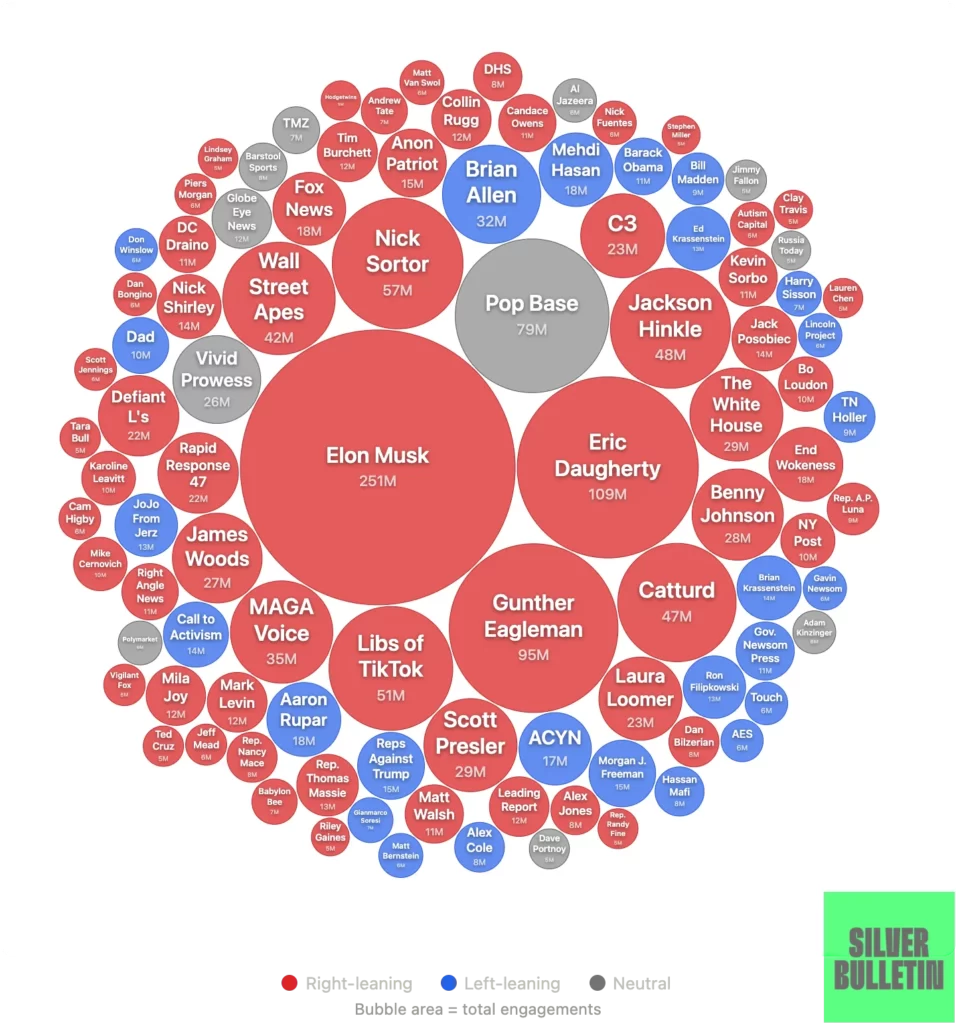
"There's a principle in ecology known as the island effect," Silver comments, where "in an isolated environment, strange things tend to happen":
There are all sorts of weird mutations that might not be survivable in a more competitive environment that can actually become fitness advantages on an island. Big animals tend to get smaller, and small animals tend to get bigger—like the Komodo dragon, whose range is limited to a few isolated islands in Indonesia.
That's basically what Twitter looks like now, "only with Catturd and the Gavin Newsom Press Office accounts locked in combat instead of a couple of (cute?) lizards."
Read This Thread
Indicators of Major Psychiatric Problems Didn't Improve After Youth Gender-Transition Treatment In Finland—They Rosehttps://t.co/sCoefigLeN
The study, which was based on comprehensive nationalized health data and included control groups, calls into question the claim that such… pic.twitter.com/ET0QboibSF— Benjamin Ryan (@benryanwriter) April 5, 2026
Ryan's thread delves into the new findings as well as sharing some criticism of them.
More Sex & Tech News
Love to see people using vibe coding tech to build tools to fight back against the government. For months, lone vibe coder Rafael Concepcion has obsessively built tools to counter the federal immigration crackdown—pivoting as he's been outmatched.
— Taylor Lorenz (@taylorlorenz.bsky.social) 2026-04-05T18:13:58.344Z
• In Missouri, a judge could decline to finalize a divorce if the woman was pregnant. House Bill 1908, which just passed both houses of the state's legislature, aims to change this.
• Was "millennial feminism" responsible for "hookup culture"? No, suggests Cartoons Hate Her. (There's a bunch I disagree with in this post, but I think the general idea that "hookup culture" was not some sort of feminist plot is probably correct…)
• Do tech companies own digital data, or do their users? This is one of the questions at the heart of an upcoming Supreme Court case—Chatrie v. United States—in which justices will consider the constitutionality of "geofence warrants."
• Sigh: People are now applying the "addiction" framework to AI agents.
No they are not. Can we stop with sloppy moral panic claims just once?
— Chris Ferguson ????
???????????????????????? (@CJFerguson1111) April 5, 2026
• "The owner of two Scottsdale gentlemen's clubs has filed a federal lawsuit against the City of Scottsdale and its police department, accusing investigators of conducting an improper and damaging probe into allegations that customers were drugged," according to 12 News Phoenix.
The post Sex Educators Say They're Being Harmed by Age Verification Laws appeared first on Reason.com.
FIP XML/RSS/RDF Newsfeed Syndication https://freeinternetpress.com/rss.php
© 2026 FreeInternetPress.com
Free Internet Press is licensed under a Creative Commons Attribution 3.0 United States License. You may reuse or distribute original works on this site, with attribution per the above license. Any mirrored or quoted materials may be copyright their respective authors, publications, or outlets, as shown on their publication, indicated by the link in the news story. Such works are used under the fair use doctrine of United States copyright law. Should any materials be found overused or objectionable to the copyright holder, notification should be sent to [email protected], and the work will be removed and replaced with such notification.
Please email [email protected] with any questions.