
Senate Advances Bipartisan Permitting Bill That Could Unleash Energy Development With Major Caveats
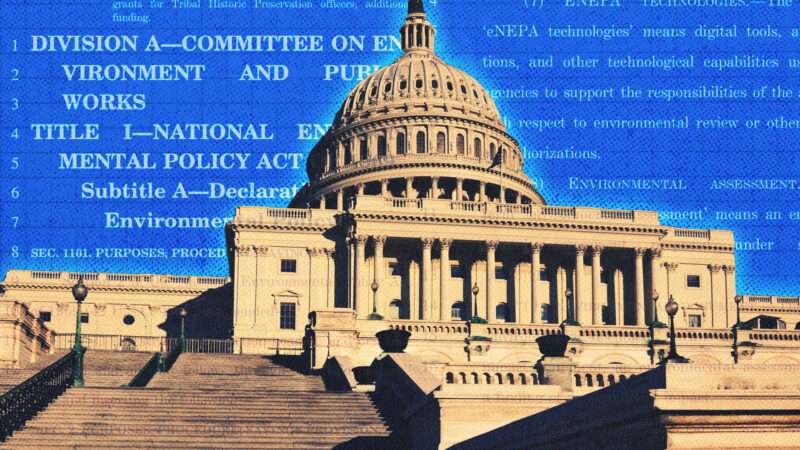
On Monday evening, the Senate moved one step closer to passing the Bipartisan American Affordability and Jobs Act (BAAJA) with a 73–25 procedural vote to bring the bill to the floor for the full chamber to consider.
Sponsored by Sen. Shelley Moore Capito (R–W.Va.), chairwoman of the Senate Environment and Public Works Committee, the 494-page bill would modify the federal permitting process by limiting the scope of environmental reviews and expediting the timeline for project approval.
The federal permitting process has stifled development in America's energy, housing, and transportation industries for decades. The average timeline to complete an environmental impact statement—the most stringent review under the National Environmental Policy Act (NEPA)—is over two years, according to a 2025 report by the White House Council on Environmental Quality.
The bill would address this challenge by expanding categorical exclusions—projects that don't require NEPA review—including for transmission and interstate natural gas pipeline repairs, upgrades, and expansions. Under the bill, modifications to energy infrastructure along existing routes and projects already evaluated by another agency would also be exempt from NEPA review. A state or tribal environmental review could also serve as NEPA compliance.
BAAJA removes permit requirements for onshore oil and gas drilling on nonfederal land, and expedites approval for renewable energy, geothermal, hydropower, or offshore energy projects. For projects in the energy and critical minerals industries, the bill sets a deadline for issuing permits that don't require environmental reviews—a year from the date of the last complete application submitted—and creates a path to petition the courts for relief if an agency fails to meet it. It also sets deadlines for federal agencies to issue permits once an environmental review is complete and limits the onerous review process under the Clean Water Act, National Historic Preservation Act, and Endangered Species Act, which are often used to stymie projects.
Critically, BAAJA addresses one of the biggest NEPA hurdles: litigation. The bill limits who can file a NEPA-related lawsuit and shrinks the statute of limitations to 150 days. Despite its goal of narrowing federal involvement in large infrastructure projects, BAAJA gives some regulators greater authority over the energy sector.
Drawing on public displeasure with data centers, the bill tasks the Federal Energy Regulatory Commission (FERC) with ensuring that data centers or cryptocurrency mining facilities "incur the full cost of the transmission service they require." It requires utilities to "provide financial assurances or contributions sufficient to cover the cost of the facility or upgrade" before making any improvements to facilities if those improvements serve data centers. A manager's amendment added to the bill last week would also expand FERC's authority by allowing the agency to issue permits for project sites on state-owned land and broaden its oversight of regional power grid operators.
With a bill this dense, plenty of groups across the political spectrum have something to applaud—in fact, BAAJA has received support from industry trade groups and the environmental lobby. At the same time, enough controversial portions could keep it from passing.
The transmission portions—which give the federal government a larger role in modernizing and expanding the nation's electric grid (a task federal regulators have proven ill suited to perform)—could prompt some conservative groups or lawmakers to withdraw support. That has sunk comprehensive permitting reform in the past. Meanwhile, a coalition of tribal nations stands opposed to the bill, arguing it usurps their authority over tribal lands and "undermines" their "ability to protect history and culture." Even prominent advocacy groups like the Sierra Club and Natural Resources Defense Council—which oppose the bill because of its environmental provisions—concede it would increase the number of clean energy projects built in the country.
President Donald Trump is also a wildcard. On Sunday, he described it as a "BIG WIN for U.S. ENERGY INDEPENDENCE and DOMINANCE," although he's stopped short of endorsing every provision. One such provision includes prohibiting federal agencies from revoking or rescinding fully permitted projects—a tactic the administration has used to stymie offshore wind projects. On Monday, Trump told reporters the bill "hasn't been fully negotiated," and that he wouldn't "approve wind turbines" as part of a deal to pass the bill "because wind turbines are a major loser."
The procedural vote is just the first step in a long legislative process to pass the bill before a new, Democratically controlled Congress begins in January. There was little pushback on the Republican side, with every party member except for Sen. Mike Rounds (R–S.D.) voting yes. Democrats have been harder to gauge, with 23 senators voting no, including Sens. Jeff Merkley (D–Ore.), Ed Markey (D–Mass.), and Bernie Sanders (I–Vt.). Minority Leader Chuck Schumer (D–N.Y.), who voted yes on the measure, said he had "outstanding concerns" with the bill and that he'll "fight to address" them during the amendment process, Axios reported Tuesday.
If BAAJA passes in the lame-duck session, it would be a major coup for America's developers, energy producers, and businesses stalled by the country's regulatory malaise for decades. However, it could also be a jumping-off point for the next Congress to assume greater government control over the U.S. economy. In a press conference after the vote, Sen. Sheldon Whitehouse (D–R.I.)—one of the bill's co-sponsors—said the current proposal is merely the "floor, not the ceiling," of Democrats' "climate and environmental aspirations."
The post Senate Advances Bipartisan Permitting Bill That Could Unleash Energy Development With Major Caveats appeared first on Reason Magazine.
FIP XML/RSS/RDF Newsfeed Syndication https://freeinternetpress.com/rss.php
© 2026 FreeInternetPress.com
Free Internet Press is licensed under a Creative Commons Attribution 3.0 United States License. You may reuse or distribute original works on this site, with attribution per the above license. Any mirrored or quoted materials may be copyright their respective authors, publications, or outlets, as shown on their publication, indicated by the link in the news story. Such works are used under the fair use doctrine of United States copyright law. Should any materials be found overused or objectionable to the copyright holder, notification should be sent to [email protected], and the work will be removed and replaced with such notification.
Please email [email protected] with any questions.