

New Jersey Supreme Court Requires Transparency for Facial Recognition Evidence
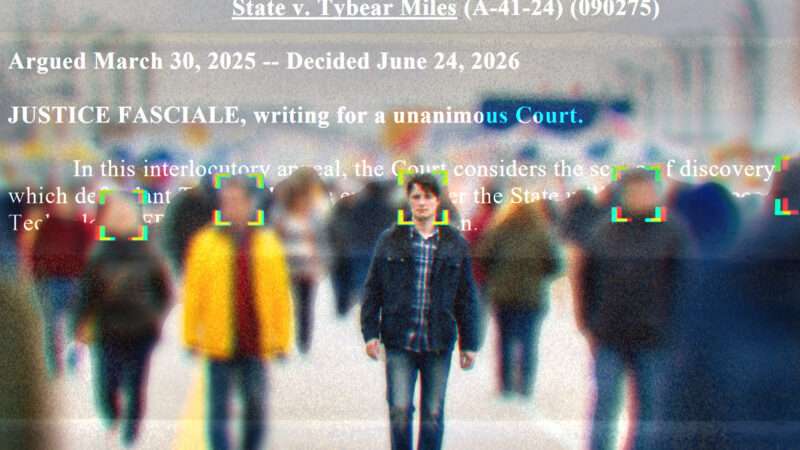
Just like humans may err in recognizing faces, facial recognition technology (FRT) is not without its flaws. Multiple defendants have blamed the technology for wrongful arrests as more and more law enforcement agencies rely on the technology to identify suspects. Meanwhile, limits on its use vary from state to state and city to city.
A ruling this week regarding a murder case in New Jersey, however, forces law enforcement to disclose how this technology is used in criminal investigations in the state.
In State v. Tybear Miles, New Jersey's Supreme Court ruled that prosecutors must disclose how FRT was used to identify defendant Tybear Miles, who had been charged with "first-degree murder and weapons offenses."
The case stems from a 2021 fatal shooting in Jersey City. A day after the shooting, officers showed a confidential informant, who did not witness the incident, CCTV footage from a nearby location. The informant identified two males by their street names and Instagram usernames, according to the ruling. After the informant identified one of the males as "Fat Daddy," police ran a photo from "Fat Daddy's" Instagram page through a facial recognition module, which identified Miles as a potential match.
The ruling notes that the state provided the defendant with two different FRT searches as part of discovery. One search, according to the ruling, "returned a list of ten possible 'matches' to the probe image of [the] defendant, with [the] defendant ranked as the eighth 'match' on the list of ten." Another search "returned a list of ten possible 'matches,' with five different images of [the] defendant ranked in the first five positions."
Miles' sister and ex-girlfriend both identified Miles from videos and still images from other nearby surveillance footage, according to the ruling. The ruling states that "no witness identified defendant as the shooter; there were several people near the victim while he was shot twice; and all of the police interviewees were shown video footage and still photographs from approximately ninety minutes before the murder and seven minutes before the murder."
Miles' defense demanded details about how FRT was used in the case, and the trial judge ordered prosecutors to hand over 13 items, citing precedent from an earlier case requiring prosecutors to hand over FRT discovery items, reported the New Jersey Monitor.
In Wednesday's ruling, the New Jersey Supreme Court partially upheld the lower court order, reported Reuters. Justice Douglas Fasciale wrote that the state is required to produce "discovery identifying the FRT tools and materials the State used in its investigation," including the name and manufacturer of the software and publicly available information about its error rates. The state must also turn over items such as the original photograph used in the probe as part of discovery. The ruling does not, however, require the state to produce the "source code of the FRT algorithm and any similar proprietary information applicable to the FRT utilized by the State," but, if warranted, a defendant could pursue a discovery request for the proprietary information.
"The right to a fair trial is guaranteed under the Federal and State Constitutions, and due process compels the State to disclose evidence favorable to an accused," asserts the ruling.
The New Jersey Chapter of the American Civil Liberties Union, which filed an amicus brief in the case, praised the ruling, and one of its attorneys called it a "major victory for civil liberties," adding it is "one of the first state high court rulings of its kind." Some states, including Maryland, Montana, and Washington, require law enforcement agencies to disclose the use of FRT to defendants before trial, but few laws and court rulings provide guidance about how the technology is used in the criminal justice system. Regardless of Miles' guilt or innocence, the ruling is an encouraging sign that more states may recognize the need for transparency regarding FRT as law enforcement increasingly relies on the technology to track and identify suspects.
The post New Jersey Supreme Court Requires Transparency for Facial Recognition Evidence appeared first on Reason.com.
FIP XML/RSS/RDF Newsfeed Syndication https://freeinternetpress.com/rss.php
© 2026 FreeInternetPress.com
Free Internet Press is licensed under a Creative Commons Attribution 3.0 United States License. You may reuse or distribute original works on this site, with attribution per the above license. Any mirrored or quoted materials may be copyright their respective authors, publications, or outlets, as shown on their publication, indicated by the link in the news story. Such works are used under the fair use doctrine of United States copyright law. Should any materials be found overused or objectionable to the copyright holder, notification should be sent to [email protected], and the work will be removed and replaced with such notification.
Please email [email protected] with any questions.