

Maryland Court Rules Against Unconstitutional Stop-and-Frisk in Victory for State's Gun Owners
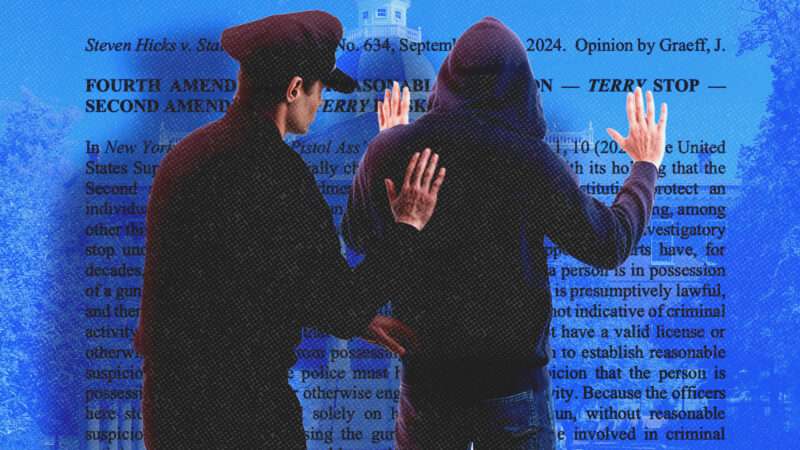
In 2023, Steven Hicks was stopped by Detective Mitchell Ramsey, an officer in the Baltimore Police Department's Group Violence Unit. After seeing a handgun "physically printing" through Hicks' shirt, Ramsey conducted a stop-and-frisk search, despite Hicks repeatedly telling officers before and during the search that he had a license to carry.
After police found cocaine on his person, Hicks was indicted on multiple drug and firearm offenses. He filed a motion to suppress the evidence, arguing that the arresting officers lacked "probable cause or reasonable suspicion" to stop and frisk him since he was licensed to carry a firearm. The Circuit Court for Baltimore City denied Hicks' motion, after which he pleaded guilty to the charges and received a five-year prison sentence without the possibility of parole.
Last week, the Appellate Court of Maryland ruled in Hicks' favor. In an opinion, the court held that Baltimore police officers violated Hicks' Fourth Amendment rights by relying solely on their suspicion that he had a firearm. For now, the ruling leaves Hicks a free man.
Writing for the court, Judge Kathryn Graeff found the initial stop by Ramsey ran afoul of the U.S. Supreme Court's holding in N.Y. State Rifle & Pistol Ass'n v. Bruen (2022), which made public carry of a firearm presumptively legal. The court also found that Detective Alex Rodriguez's search of Hicks' satchel and pockets "exceeded the scope of a Terry frisk," which is limited to a pat-down of outer clothing.
The appellate court's ruling affirms the Second Amendment rights of Maryland residents and could meaningfully change police departments' stop-and-frisk practices across the state.
Because Rodriguez didn't testify, the state had little evidence to justify the search under the "plain sight and plain feel doctrines." While patting Hicks down, Rodriguez put his hands "slightly into" the satchel around Hicks' body. He then pulled the satchel away from Hicks, felt the outside of the satchel, and announced there was another gun inside.
Rodriguez then continued to search Hicks, going through his pockets until he found "small baggies" and "numerous small plastic containers" filled with a substance later identified as cocaine. Based only on the footage from Rodriguez's body camera, there was no proof that the additional handgun and drugs seized were in plain view or plain feel. However, the court noted that the frisk would have been permissible had the initial stop been lawful.
Before the Bruen decision, Maryland was a "may-issue" state, meaning it limited gun licenses to people who had a "good and substantial reason" to fear for their safety. In October 2023—while Hicks' appeal was pending—Maryland became a "shall issue" state, granting a gun license to any adult who met a broad set of requirements and passed a firearms safety course.
Under the "may-issue" laws, Maryland courts had consistently held that possession of a handgun was "presumptively illegal." Hence, an investigatory stop was legal if cops had a "reasonable suspicion" that the person was carrying a concealed firearm.
The government based its case on this prior interpretation, arguing that the presumption of legality depended on "each State's substantive criminal law, not Bruen." The appellate court rejected this argument, citing several court rulings post-Bruen that found the presumption that anyone in possession of a firearm is engaged in unlawful conduct "inconsistent" with the Constitution, the Terry doctrine, and the Fourth Amendment.
In U.S. v. Wilson (2025), the 5th Circuit Court of Appeals found that even though Louisiana had a "shall-issue" permitting structure similar to Maryland's, "keeping and bearing arms is presumptively lawful nationwide," meaning cops can't suspect someone of a crime or engaging in criminal activity solely because they have a firearm.
The ruling backed up a previous opinion issued by the 5th Circuit in U.S. v. Daniels (2025), in which the court found officers can't "look with suspicion on citizens presumably lawfully exercising their Second Amendment rights."
In an email to Reason, Lindsey Eldridge, chief of public affairs for the Baltimore Police Department, says the department is "aware of the Appellate Court of Maryland's opinion" and is "currently reviewing the court's decision and evaluating its implications," in consultation with the City's Law Department.
Baltimore City State's Attorney Ivan Bates tells Reason the ruling will "require officers to articulate additional facts indicating criminal activity beyond mere possession of a gun before conducting a stop." Still, the city police are already training officers to "rely on as many factors as possible when establishing reasonable articulable suspicion."
It's not all good news for Maryland gun owners; the appellate court did note that the standard set by Bruen is "arguably" not a "positive change," reasoning it could place limits on cops' ability to "thwart danger to the public."
Still, the ruling will likely protect law-abiding gun owners in Maryland from frivolous searches conducted by police in the state, guaranteeing a freedom already granted to them by the U.S. Constitution.
The post Maryland Court Rules Against Unconstitutional Stop-and-Frisk in Victory for State's Gun Owners appeared first on Reason.com.
FIP XML/RSS/RDF Newsfeed Syndication https://freeinternetpress.com/rss.php
© 2026 FreeInternetPress.com
Free Internet Press is licensed under a Creative Commons Attribution 3.0 United States License. You may reuse or distribute original works on this site, with attribution per the above license. Any mirrored or quoted materials may be copyright their respective authors, publications, or outlets, as shown on their publication, indicated by the link in the news story. Such works are used under the fair use doctrine of United States copyright law. Should any materials be found overused or objectionable to the copyright holder, notification should be sent to [email protected], and the work will be removed and replaced with such notification.
Please email [email protected] with any questions.