

MSNBC Pundit's Tweet Accusing Lawyer of "Coach[ing]" Jan. 6 Hearing Witness "to Lie" Wasn't Negligent
From today's decision by Judge Loren AliKhan (D.D.C.) in Passantino v. Weissmann (for an earlier decision in the case, see here):
Plaintiff Stefan Passantino brings this action against Defendant Andrew Weissmann, alleging defamation stemming from a September 2023 social media post. In the post, Mr. Weissmann referred to Mr. Passantino—a lawyer—as someone "who coached [a witness appearing before Congress] to lie." …
In 2021, the House of Representatives established a Select Committee to investigate the January 6, 2021 attack on the U.S. Capitol. As part of its investigation, the Select Committee interviewed numerous witnesses, including Cassidy Hutchinson, a former special assistant to President Trump who had been serving under the direction of White House Chief of Staff Mark Meadows on January 6, 2021.
Mr. Passantino [a former Trump administration senior lawyer] represented Ms. Hutchinson at her first three closed-door Select Committee depositions on February 23, March 7, and May 17, 2022. In early June 2022, after the third deposition, Ms. Hutchinson fired Mr. Passantino and retained new counsel. She subsequently gave a fourth, televised deposition on June 28, which received substantial media coverage.
After her fourth deposition, Ms. Hutchinson sent a letter to the Select Committee stating that she intended to "waive [her] attorney-client privilege [with Mr. Passantino] in order to share information with the [C]ommittee that[] [was] relevant to [her] prior testimony." The Select Committee scheduled her for a fifth, closed-door deposition for September 14, 2022. According to Ms. Hutchinson, she had asked a friend to "back channel to the committee and say that there [were] a few things that [she] want[ed] to talk about." … [She also said] that she did "not [want to] let Stefan [Passantino] know that [she was] back channeling for this interview" ….
At her fifth deposition, Ms. Hutchinson testified about the preparation she and Mr. Passantino had conducted ahead of her first Select Committee deposition. Specifically, she told the Committee that she and Mr. Passantino had met "for a couple hours" on February 16, 2022 to discuss her upcoming testimony. When Ms. Hutchinson suggested printing out a calendar so that she could "get[] the dates right" with respect to timelines of events, Mr. Passantino said "No, no, no." He told her: "We're going to downplay your role" and "the less you remember, the better." When Ms. Hutchinson brought up an incident that occurred inside the presidential limousine on January 6 (about which she had been told by a colleague), Mr. Passantino said "No, no, no, no, no. We don't want to go there. We don't want to talk about that."
Mr. Passantino told Ms. Hutchinson: "If you don't 100 percent recall something, even if you don't recall a date or somebody who may or may not have been in the room, ['I don't recall' is] an entirely fine answer, and we want you to use that response as much as you deem necessary." Ms. Hutchinson then asked, "if I do recall something but not every little detail, … can I still say I don't recall?" to which Mr. Passantino replied, "Yes." The morning of the first deposition, Mr. Passantino reminded Ms. Hutchinson to "[j]ust downplay [her] position," telling her that her "go-to [response was] 'I don't recall.'"
Ms. Hutchinson also discussed a line of questioning from her first deposition about the January 6 incident in the presidential limousine. She explained that, during a break after facing repeated questions on the topic, she had told Mr. Passantino in private, "I'm f[*****]. I just lied." Mr. Passantino responded, "You didn't lie…. They don't know what you know, Cassidy. They don't know that you can recall some of these things. So you saying 'I don't recall' is an entirely acceptable response to this." He concluded, "You're doing exactly what you should be doing." Ms. Hutchinson explained that, in the moment, she "[felt] like [she] couldn't be forthcoming when [she] wanted to be." Id. 56:3-4.
Ms. Hutchinson did, however, state: "I want to make this clear to [the Select Committee]: Stefan [Passantino] never told me to lie." She recalled him saying to her: "I don't want you to perjure yourself, but 'I don't recall' isn't perjury. They don't know what you can and can't recall." Ms. Hutchinson then reiterated to the Select Committee, "[H]e didn't tell me to lie. He told me not to lie." Mr. Passantino acknowledges that the deposition transcript accurately reflects Ms. Hutchinson's statements at her fifth deposition, although he disputes the veracity of her account except to the extent Ms. Hutchinson testified that he instructed her not to lie.
At the Committee's final public session on December 19, 2022, Representative Zoe Lofgren stated that the Committee had "obtained evidence" that "one lawyer told a witness the witness could in certain circumstances tell the Committee that she didn't recall facts when she actually did recall them."
After the Committee released the transcripts of Ms. Hutchinson's closed-door depositions, multiple news outlets identified Mr. Passantino as the "lawyer" that Representative Lofgren had referenced.
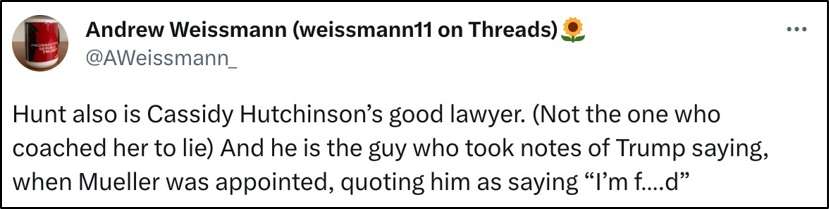
Nine months later, Mr. Weissmann—a former prosecutor who now serves as a "political pundit" for MSNBC—posted the following on Twitter (now known as X):
Mr. Weissmann made the post in response to an alert that Mr. Hunt had received a subpoena in an unrelated case. Mr. Weissmann had approximately 320,000 followers on X at the time….
Passantino sued, but the court granted judgment for Weissmann:
The court concludes that Mr. Passantino has failed to plead the requisite level of fault …. "If the plaintiff [in a defamation suit] is a private figure, then negligence is the applicable fault standard." "But if the plaintiff is a public figure," then the plaintiff must demonstrate "that the defamatory statement was made with 'actual malice,' i.e., 'with knowledge that it was false or with reckless disregard of whether it was false or not.'" … Because the court concludes that Mr. Passantino fails to plead facts sufficient to establish negligence, the court assumes without deciding that Mr. Passantino is a private figure.
To allege negligence, a plaintiff must plead facts showing that a defendant failed "to observe an ordinary degree of care in ascertaining the truth of an assertion before publishing it to others." …
Mr. Passantino … contend[s] that the transcripts [of Ms. Hutchinson's testimony] "showed that Mr. Passantino had done nothing to obstruct or shape Ms. Hutchinson's testimony and indeed showed the opposite as [Ms. Hutchinson] stated that 'Stefan [Passantino] never told me to lie' and that 'he told me not to lie.'" The court assumes as true Mr. Passantino's allegation that Mr. Passantino "had done nothing to obstruct or shape Ms. Hutchinson's testimony." …
Mr. Passantino's direct quotations from the transcript fail to show that Mr. Weissmann had reasonable notice that his statement was false. Mr. Passantino relies on Ms. Hutchinson's statements stressing that "Stefan [Passantino] never told me to lie." But taking those statements as true does not resolve the relevant question: whether a reasonable person in Mr. Weissman's shoes could have concluded that Mr. Passantino "coached [Ms. Hutchinson] to lie."
To "coach" means "to instruct, direct, or prompt." It is perfectly possible to direct or prompt someone to lie without expressly stating as much. Indeed, Mr. Weismann acknowledges Ms. Hutchinson's full account of Mr. Passantino's statements—including that Mr. Passantino expressly told her not to lie—but he argues that Mr. Passantino nonetheless coached her to make false statements to the Select Committee by telling her to say she did not recall answers to their questions even when she did….
The court concludes that Mr. Passantino's claims about the message of the transcript are not only legally conclusory, but also incorrect. The transcript, far from contradicting Mr. Weissman's statement, supports it. Ms. Hutchinson's statements indicate that Mr. Passantino repeatedly prompted Ms. Hutchinson to lie. For example, Mr. Passantino's advice included telling Ms. Hutchinson that "Your go-to, Cass, is 'I don't recall,'" even when she asked about answering "certain questions that [she] would recall." When Ms. Hutchinson told Mr. Passantino, "I'm f[*****]. I just lied," Mr. Passantino purportedly responded, "You didn't lie…. They don't know what you know, Cassidy. They don't know that you can recall some of these things. So you saying 'I don't recall' is an entirely acceptable response to this." He concluded, "You're doing exactly what you should be doing."
In other words, the transcript reflects that even as Mr. Passantino nominally instructed Ms. Hutchinson not to lie, he repeatedly urged her to say "I don't recall" based on the unverifiability of that response—not based on its truth. He encouraged her to say "I don't recall" whenever the Committee would not know the difference, even when Ms. Hutchinson indicated to him that she did in fact recall relevant information.
Second, Mr. Passantino suggests that Mr. Weissman should have known that Ms. Hutchinson had "self-interested, political motives" to "distance herself from her prior testimony" by blaming Mr. Passantino. Although Mr. Passantino describes "aspects of Ms. Hutchinson's testimony" as "contradictory and uncredible," he does not allege any facts that would require a reasonable reader to inquire further.
A reasonably careful person may rely on sworn testimony without taking additional steps to verify it because the deponent both speaks from personal knowledge and swears to tell the truth under penalty of perjury. Mr. Passantino asserts in his opposition brief that "many reasonable readers" would have interpreted Ms. Hutchinson's September 14 testimony as that of "a fabulist who wanted to distance herself from her prior testimony so that she could spread inflammatory gossip and hearsay." But the court rejects this assertion, which is untethered from any facts in the complaint and wholly speculative.
Moreover, the standard for negligence is not whether "a reasonable reader could view Ms. Hutchinson's testimony as being consistent with" Mr. Passantino's pleaded truth; it is whether a reasonable reader should have known that Mr. Passantino's pleaded truth was the objective truth or at least should have had sufficient doubts as to trigger an obligation to inquire further. Even assuming the truth of Mr. Passantino's pleadings, Mr. Weissmann "had reasonable grounds for believing that [his] communication was true."
Lest there be any doubt, a reasonable person attempting to verify Mr. Weissman's statements would have found ample sources of support. Representative Lofgren told the public at a highly publicized congressional hearing that the Select Committee had "obtained evidence" that "one lawyer told a witness the witness could in certain circumstances tell the Committee that she didn't recall facts when she actually did recall them." And numerous mainstream media outlets promptly identified Mr. Passantino as the lawyer in question. Mr. Passantino argues that there is "no record evidence that [Mr. Weissmann] actually viewed or otherwise knew of these media articles." Nevertheless, Representative Lofgren's statement and the public reporting on it reflect and support the objective reasonableness of Mr. Weissman's statement because large swaths of people, including reporters held to a higher standard of care, drew the same conclusions from the same testimony.
While Mr. Passantino cites other media articles to show that "many did, in fact, question Ms. Hutchinson's credibility," those articles at most demonstrate that reasonable minds could have differing views on the matter. Mr. Passantino does not allege that a reasonably prudent person should have sought out articles that assessed Ms. Hutchinson's credibility, let alone that such articles rendered Mr. Weissman's amply supported statement negligent. The court accordingly concludes that Mr. Passantino fails to plead any facts that could support a claim that Mr. Weissmann was negligent for purposes of his defamation claim.…
Meryl C. Governski and Linda E. Halfacre (Dunn Isaacson Rhee LLP), Jonathan I. Kravis (Munger, Tolles & Olson LLP), and Faith E. Gay, Corey Stoughton, and Rachel Slepoi (Selendy Gay PLLC) represent defendants.
The post MSNBC Pundit's Tweet Accusing Lawyer of "Coach[ing]" Jan. 6 Hearing Witness "to Lie" Wasn't Negligent appeared first on Reason Magazine.
FIP XML/RSS/RDF Newsfeed Syndication https://freeinternetpress.com/rss.php
© 2026 FreeInternetPress.com
Free Internet Press is licensed under a Creative Commons Attribution 3.0 United States License. You may reuse or distribute original works on this site, with attribution per the above license. Any mirrored or quoted materials may be copyright their respective authors, publications, or outlets, as shown on their publication, indicated by the link in the news story. Such works are used under the fair use doctrine of United States copyright law. Should any materials be found overused or objectionable to the copyright holder, notification should be sent to [email protected], and the work will be removed and replaced with such notification.
Please email [email protected] with any questions.