
Iran Is Turning America's Sanctions Playbook Against It
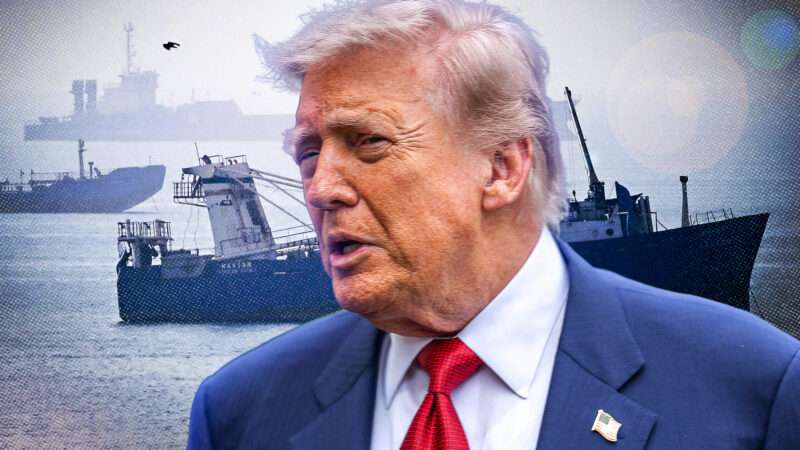
The U.S. government has made it illegal to pay Iran a toll to pass through the Strait of Hormuz. On Thursday, the Department of the Treasury's Office of Foreign Asset Control (OFAC) imposed sanctions on Iran's Persian Gulf Strait Authority, forbidding anyone who deals in U.S. dollars from doing business with the Iranian government body collecting the payments.
"The U.S. Treasury will aggressively target any actors involved—directly or indirectly—in facilitating tolls for the Strait and any willing partners will be penalized," Secretary of the Treasury Scott Bessent declared. "All nations should reject outright any efforts by Iran to disrupt the free flow of commerce."
It's easy to miss it, but this action is a dramatic and strange inversion of Washington's economic strategy. OFAC's usual job is to stop the free flow of commerce by enforcing trade embargoes and financial sanctions on foreign enemies. The Trump administration in particular has gotten fond of using sanctions (and tariffs) to pressure friends and foes alike.
U.S. sanctions were historically so effective because almost all of the world's trade touches the U.S. financial system, directly or indirectly. Even non-American banks would refuse to deal with sanctioned customers for fear of being sanctioned themselves. In recent months, the Trump administration escalated from paper sanctions to physical attacks on Venezuelan and Iranian shipping. But the message was the same: Trading with these nations is not worth the risk. Making an example out of one business would scare the others into compliance.
Now Iran is playing this game in reverse. After the U.S.-Israeli attack in February, the Iranian navy declared the Strait of Hormuz closed and began attacking foreign ships in the Persian Gulf. Throughout the war, the Iranian government developed more systematic control over the waterway, banning ships from hostile nations, charging others ransom to cross through a mine-free safe lane, and cutting side deals with friendly nations.
Proponents of U.S. sanctions often liked to say that they were forcing international business to choose between Iranian markets and the U.S. dollar. With the tollbooth, Iran is presenting foreign countries with their own choice between U.S. support and petrochemical supply chains.
And the U.S. Treasury is reacting in the way that foreigners have historically reacted to U.S. sanctions. In the 1990s, the European Union passed a "blocking statute" that banned its companies from obeying non-European sanctions. (The rule turned out to be basically unenforceable.) China passed its own blocking statute in 2021, and invoked it for the first time this month, ordering refineries to continue buying Iranian oil in the face of U.S. sanctions. The ban on paying Hormuz tolls is in the same vein.
Bessent said that the sanctions were a warning aimed "in particular" at Oman, the Arab monarchy that sits opposite Iran on the Strait of Hormuz. Iran has publicly offered Oman a share in the Hormuz tollbooth, and Omani officials were privately in talks over implementation, The New York Times reported last week. The "toll" would be renamed a "fee for services" to be less provocative, according to the Times.
The Trump administration wasn't buying the rebranded toll. "Oman will behave like everybody else or we'll have to blow them up," President Donald Trump warned at a Wednesday cabinet session. After Bessent and Trump's threats, Bessent told reporters that Oman has "no plans for tolling the strait."
Trump threatening Oman with physical violence in response to a trade restriction is another ironic echo of the U.S.-Iranian conflict. Iran has demanded U.S. sanctions relief—specifically, access to Iranian dollars currently frozen in foreign bank accounts—as a condition of ending the war. More than the paltry revenue it generates, the Hormuz tollbooth is valuable to Iran because it allows the country to forcibly undermine the U.S. sanctions regime. Iranian First Vice President Mohammad Reza Aref said last month that the toll scheme would make foreign sanctions "practically ineffective."
That is the future of economic sanctions. They were once a game of cat-and-mouse between U.S. regulators, who scoured the banking system for forbidden transactions, and foreign merchants, who tried to hide their trade behind increasingly complex layers of paperwork. Now sanctions are a direct extension of warfare—and U.S. opponents are learning to manipulate business risk to their advantage. The future for free global trade looks bleak.
The post Iran Is Turning America's Sanctions Playbook Against It appeared first on Reason.com.
FIP XML/RSS/RDF Newsfeed Syndication https://freeinternetpress.com/rss.php
© 2026 FreeInternetPress.com
Free Internet Press is licensed under a Creative Commons Attribution 3.0 United States License. You may reuse or distribute original works on this site, with attribution per the above license. Any mirrored or quoted materials may be copyright their respective authors, publications, or outlets, as shown on their publication, indicated by the link in the news story. Such works are used under the fair use doctrine of United States copyright law. Should any materials be found overused or objectionable to the copyright holder, notification should be sent to [email protected], and the work will be removed and replaced with such notification.
Please email [email protected] with any questions.