

FBI Goes After Whistleblower Who Helped Unmask the 'Fort Bragg Cartel'
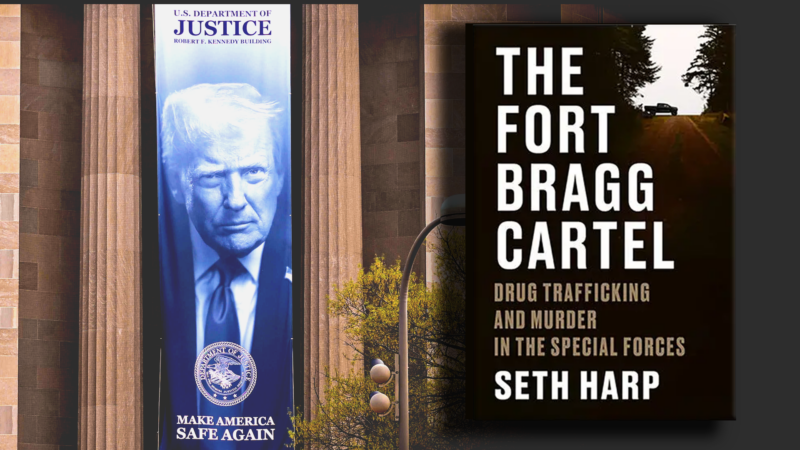
Courtney Williams never made her gripes with the military a secret. In the mid-2010s, she filed a discrimination complaint with the Equal Employment Opportunity Commission (EEOC) about her time as a civilian staffer at Fort Bragg in North Carolina, settling the complaint in exchange for an undisclosed sum of money in 2018. She later spoke to the journalist Seth Harp for the book The Fort Bragg Cartel, which centered around the murder of two soldiers at the center of a massive corruption and drug-trafficking ring in the Joint Special Operations Command (JSOC).
"It was like they were trying to herd cattle, or take care of a bunch of children," Williams told Harp, recalling stories of JSOC operators showing up drunk to work and sexually harassing their colleagues, sometimes while throwing tomahawk axes into the walls or jokingly packing explosives into desks. Her testimony, which was also published as an excerpt in Politico, helped Harp paint a picture of the rampant substance abuse and fratricidal violence in JSOC.
Now, the FBI wants to cast Williams, who served in the Army before her civilian work at Fort Bragg, as a "leaker." In a Wednesday press release, the U.S. Department of Justice (DOJ) announced that it was charging her under the Espionage Act. "Anyone divulging information they vowed to protect to a reporter for publication is reckless, self-serving and damages our nation's security," FBI Special Agent Reid Davis said in the press release.
"Courtney Williams is a courageous whistleblower who exposed rampant gender discrimination and sexual harassment in the U.S. Army's Delta Force. Unlike many of my sources, she was adamant that she be quoted by name and made no attempt to conceal her identity because her actions were entirely above-board, legitimate, and admirable," Harp said in a statement. "Is it classified that many Delta Force operators and officers sexually harass and discriminate against women in the workplace? Because that was the main thrust of Courtney's testimony."
He noted that many former Delta Force operators and Navy SEALs regularly discuss the same kinds of information she did on podcasts and YouTube shows, and that the DOJ singled out Williams "to retaliate against a woman who only sought to improve workplace conditions for female soldiers and civilian employees of the military."
The indictment against Williams claims that some of her statements to Harp "contained information that is properly classified as SECRET" because it touched on the "tactics, techniques, and procedures" used by the Mission Support Troop, an office that managed cover identities for JSOC operatives. It also alleges that Williams sent Harp a USB drive that "likely contained" classified data. Harp says that the drive contained a copy of her EEOC case documents.
The Fort Bragg Cartel does indeed go into the specifics of JSOC missions. Williams visited different front offices around the country, checking the mail and paying the bills for fake businesses. She also came up with a way to create confusion around operators' real identities, by attaching multiple Social Security numbers for the same legal name and leaving contradictory breadcrumbs on social media. Williams mentioned that China was the hardest country to fool, and Israel was the only country Delta Force wasn't allowed to spy on.
"We'd get executive-level orders from the White House to either collect information or capture a target, or to kill, depending on what the mission was.…Usually we were going after high-profile targets that nobody knew the American government was after," the book quotes Williams as saying. "The things you see on TV and think they don't exist, they really do exist."
According to the indictment, Williams texted Harp after publication, "I thought things I was telling you so you could have a better general understanding of how the [Mission Support Troop] was set up or operated would not be published and it feels like an entire TTP [tactics, techniques, and procedures] was sent out in my name giving them a chance to legally persecute me." She also complained to her mother, "I might actually get arrested, and I don't even get a free copy of the book."
Past administrations have used the Espionage Act against journalists' sources before. The Nixon administration famously prosecuted Daniel Ellsberg for leaking the Pentagon Papers, a top-secret internal history of the Vietnam War, only for a judge to declare a mistrial. The Obama administration went after Chelsea Manning, who gave WikiLeaks a trove of diplomatic cables and Army reports, and Edward Snowden, who disclosed NSA mass surveillance. The first Trump administration prosecuted Daniel Hale, who sent The Intercept documents about how the drone assassination program worked, and Reality Winner, who leaked an intelligence report about Russian election interference to the same publication.
But unlike all of those other whistleblowers, Williams was not leaking documents in secret. She was speaking publicly, in her own name, to a reporter. The only similar case in history may be the prosecution of John Kiriakou, a former CIA officer who spoke to the media about the agency's torture programs. The Obama administration first tried to charge Kiriakou under the Espionage Act, but dropped those charges and got Kiriakou to instead plead guilty for revealing a colleague's cover identity.
In his second term, President Donald Trump has moved much more aggressively against media leaks. Earlier this year, the FBI raided the house of Washington Post reporter Hannah Natanson and seized her electronics as part of a leak investigation. (The judge who signed the warrant later accused the administration of deceiving him about the case.) This week, Trump threatened to arrest the journalists who reported that a U.S. airman was missing in Iran. Then he said there was a "Federal Investigation" into the "total Fraudsters, Charlatans, and WORSE" reporting on his ceasefire negotiations with Iran.
FBI Director Kash Patel made it clear on Wednesday that prosecuting Williams was meant to be "a message to any would-be leakers: we're working these cases, and we're making arrests."
During her legal battle with the government, Williams worried that her colleagues might try to violently shut her up. "Am I going to be one of these people who dies in a car crash and it's not really a car crash?" she remembered thinking to herself at a traffic light, according to The Fort Bragg Cartel. She probably didn't imagine that the president of the United States would decide to publicly make an example of her.
The post FBI Goes After Whistleblower Who Helped Unmask the 'Fort Bragg Cartel' appeared first on Reason.com.
FIP XML/RSS/RDF Newsfeed Syndication https://freeinternetpress.com/rss.php
© 2026 FreeInternetPress.com
Free Internet Press is licensed under a Creative Commons Attribution 3.0 United States License. You may reuse or distribute original works on this site, with attribution per the above license. Any mirrored or quoted materials may be copyright their respective authors, publications, or outlets, as shown on their publication, indicated by the link in the news story. Such works are used under the fair use doctrine of United States copyright law. Should any materials be found overused or objectionable to the copyright holder, notification should be sent to [email protected], and the work will be removed and replaced with such notification.
Please email [email protected] with any questions.