

Elon Musk's Mistaken Call for a 'Universal High Income'
Even before artificial intelligence was a meaningful force in the economy, technologists, politicians, and policy wonks of all political persuasions have endorsed a universal basic income to cope with the mass unemployment that will be caused by the AI revolution.
The familiar case is that an AI-powered economy will be able to automate most economic production, making the economy as a whole much richer, but leaving the average person jobless and destitute. The solution is then to redistribute some of the gains from AI to the public by sending everyone, regardless of income, a check.
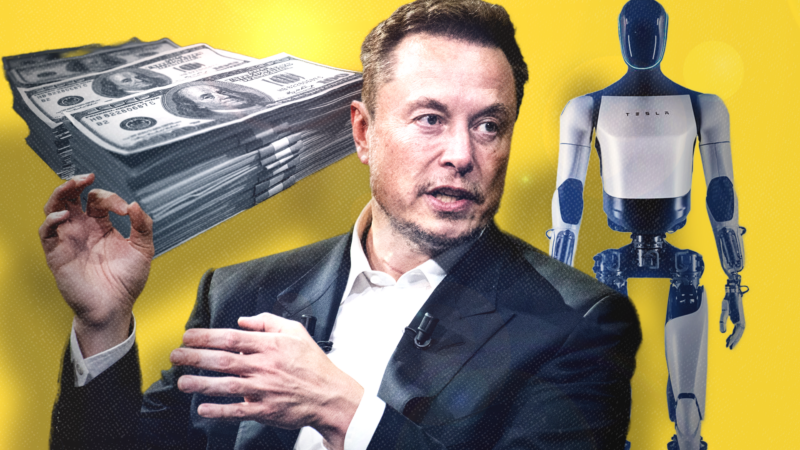
Businessman Elon Musk has gone one step further by calling for a "universal HIGH INCOME" to pay for the AI-induced unemployment, which he suggested would be inflation-free thanks to the downward pressure AI will put on prices.
Universal HIGH INCOME via checks issued by the Federal government is the best way to deal with unemployment caused by AI.
AI/robotics will produce goods & services far in excess of the increase in the money supply, so there will not be inflation.
— Elon Musk (@elonmusk) April 17, 2026
Musk is almost certainly right that AI will put downward pressure on prices, as one would expect of any productivity-enhancing technology.
He's mistaken in believing that this makes a universal income (regardless of whether it's basic or "HIGH") a wise policy.
Even in a future in which AI does revolutionize the economy, we will not see technologically driven mass unemployment. In fact, a universal basic income would likely result in more of the joblessness it's meant to mitigate.
To the first point, the industrial revolution has been outsourcing more and more tasks to labor-saving machines for roughly 300 years now. While this ongoing process has certainly made lots of individual jobs obsolete, it has not made jobs generally obsolete.
Excepting the monthly ups and downs of the unemployment rate, the total number of jobs in the economy continues to rise precipitously in the long run.
If labor-saving technology destroyed the need for labor, we should have fewer jobs today than ever before. We don't. Even as farms and factories employ fewer people, we keep finding ways to keep ourselves busy.
The AI boosters and doomers argue that this time will be different, because unlike spinning jennies, combine harvesters, and email, AI will eventually be smarter than humans at everything. When there's nothing that flesh-and-blood humans can do better than machines, we'll end up doing nothing at all.
These arguments are obviously speculative because we don't have artificial general intelligence yet. Even when we do, it's reasonable to assume that humans will continue to have employable comparative advantages, if only because humans prize human interaction.
There are lots of jobs today that could be automated but aren't. Plenty of people work in offices even if their tasks could be completed remotely. So long as people are social creatures, I can only assume we'll find something marketable to do with our time.
Outside of speculative future scenarios, here in the real world, the economic impact of AI continues to look similar to the impacts of past productivity-enhancing technological innovations. That's true even in industries that have been most influenced by AI.
Language translation is something that AI has long been pretty good at, and language translation services have become increasingly automated over time.
When journalist Timothy Lee looked at the impact of AI on the industry in 2023, he found that the technology had caused prices for translation to fall, and more consumption of translation services. Translators themselves were adapting by either specializing in translation of legal or medical texts (which still requires human oversight), using AI to increase their productivity, or dropping out of the industry.
The effects of AI on translators weren't all positive. But that basic story of falling prices, rising productivity, some jobs disappearing, and others becoming more specialized sounds a lot like every industry revolutionized by technology.
The evidence that AI will finally be the technology that puts everyone out of work just isn't there.
Economic transitions don't happen automatically. It will take time for people to find new jobs as AI destroys the old ones.
That's precisely why a universal basic income or ("HIGH INCOME") would be so dangerous to adopt.
A pretty robust finding in the research is that giving people unconditional cash grants leads them to work less and even stop working at all if the benefits are generous enough.
Pairing advancing AI with a universal basic income would give people a major incentive not to work, right as many existing jobs are being automated away. Instead of people finding their next comparative advantage in an economy being made more productive but also automated by AI, many would probably just stay home instead.
Far from mitigating the employment effects of AI, a universal income would seem to usher in the jobless dystopia that those convinced of AI's transformative effects are worried about.
We should have a little faith in humans and technology. For centuries, technological progress has made us richer while creating more jobs. The only way AI will be different is if we use its productivity gains to pay people not to work.
The post Elon Musk's Mistaken Call for a 'Universal High Income' appeared first on Reason.com.
FIP XML/RSS/RDF Newsfeed Syndication https://freeinternetpress.com/rss.php
© 2026 FreeInternetPress.com
Free Internet Press is licensed under a Creative Commons Attribution 3.0 United States License. You may reuse or distribute original works on this site, with attribution per the above license. Any mirrored or quoted materials may be copyright their respective authors, publications, or outlets, as shown on their publication, indicated by the link in the news story. Such works are used under the fair use doctrine of United States copyright law. Should any materials be found overused or objectionable to the copyright holder, notification should be sent to [email protected], and the work will be removed and replaced with such notification.
Please email [email protected] with any questions.