

Americans Would Rather Win the Midterms Than a Sports Title. Here's Why That Might Be.
Hello and welcome to another edition of Free Agent! No need to pass on the newsletter this week, you can run your way to victory.
The Reason staff are busy bearing down for midterms, so our newsletter today is a little bit short. But we'll dive into a fascinating new survey on politics and sports—one that I wish had opposite results.
Locker Room Links
- Russia is coming back to international hockey tournaments after a court order—but several countries already say they refuse to play Russia, complicating things.
- Spanish soccer player Jesús de Miguel died after the opposing goalkeeper ran into him at full speed late in a LaLiga 2 match. The goalkeeper may be charged with involuntary manslaughter (and yes, he got a straight red card).
- Premier League team Aston Villa threatened to sue soccer analyst Jamie Carragher, who had the audacity to say "shut the fuck up Aston Villa fans. Aston Villa will never be Manchester United." Carragher apologized, like a coward, and Aston Villa decided against legal action.
- The NFL has, again, lost the antitrust case over the Sunday Ticket TV package. (In short, they lost the case but will probably have to pay less in damages than initially thought.)
- The fine people of Austin, Texas, are tired of so many police escorts disrupting traffic during Formula 1 race weekend. (As an office worker in the Motorcade Capital, I commiserate.)
- For Halloween, New Mexico gubernatorial candidate Deb Haaland dressed up as "the other Haaland" (famous soccer player Erling).
- Billionaire sports owners made big donations to politicians before the midterm elections.
- Elsewhere in Reason: "Jacksonville's $775 Million Stadium Deal Was Sold on a Super Bowl the Jaguars' Owner Says Won't Happen" (or, if you want to hear people talk about the election: "What Do Libertarians Have To Gain From the Midterms?")
- State governments can just do things (but it doesn't mean they should).
US states whose official sport is jousting pic.twitter.com/6zJ3HVoH1G
— Terrible Maps (@TerribleMaps) November 1, 2026
People Should Care Less About Politics and More About Sports
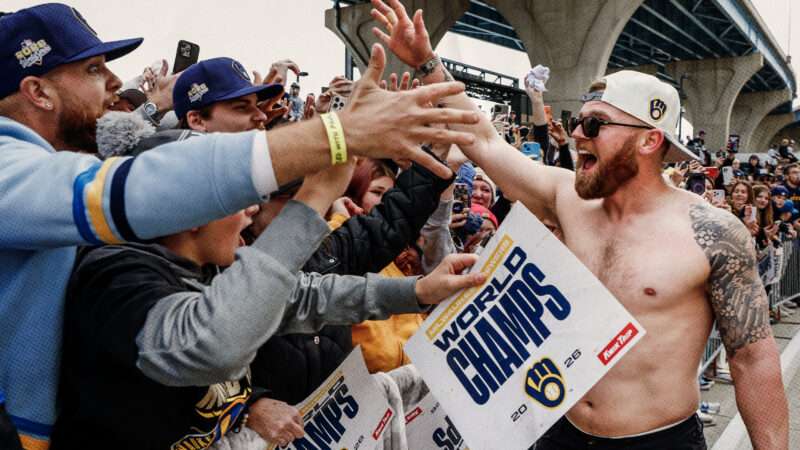
When the Milwaukee Brewers clinched their first-ever World Series title last week, the good people of Wisconsin poured into the streets to celebrate, the Miller Lite flowed endlessly, and a raucous victory parade was swiftly planned (Brewers gear was even allowed in court!). But all those wild celebrations are apparently nothing compared to what Americans have planned for election night if their preferred congressional candidate comes out on top.
Or so a recent survey out of Seton Hall would lead us to believe, anyway.
About 47 percent of Americans say they'd rather have the congressional candidate(s) they support win in the midterm elections than have their favorite team win the championship. To be specific, those 47 percent say they disagreed with this statement: "I would rather that my favorite team/athlete win their respective championship (e.g., World Series, Super Bowl, college national championship, etc.) than the Congressional candidate(s) I support win in the November 3th, 2026 election." Just 25 percent said they'd rather have a title-winning team, and 28 percent didn't say either way. Even among self-described avid sports fans, just 42 percent prefer a championship to 40 percent who'd rather have a congressional victory. People aged 55 and up are most likely to betray their sports teams for a politician (in my words), with just 14 percent preferring a sports title compared to 35 percent of the age 18–34 crowd.
I cannot fathom preferring a congressional election win over a championship.
A title is a lifelong memory, while 10 years from now no one will remember who ran against who in the vast, vast majority of congressional elections. Championship banners live forever, while congressional victories last just two, or six, years. The quality of my congressional candidates in Northern Virginia is, to be fair, pretty low—but even if my favorite politician were elected to Congress, they'd have the power of just 1 of 100 people in the Senate, or 1 in 435 in the House of Representatives.
The preference for political victory is a little more understandable if we're talking about a presidential election, since the president has so much more power for direct action (60 percent of the public preferred their presidential candidate win over a sports championship, according to a similar Seton Hall survey in 2024—even 50 percent of "avid sports fans" agreed). But even then, no president is going to deliver on every campaign promise and deliver your personal utopia (or dystopia if it's a president you hate), so I'd still rather have a Tigers World Series title in my lifetime.
Besides, a politician wins and then has to deliver on their promises—but in sports, winning the championship is the whole point.
What this all shows is that the federal government has grown too big, too powerful, and too important in the daily lives of average people. The preference for a congressional victory over a sports victory probably has more to do with a preference against the other side than a preference for a particular candidate. Americans live in fear of the political other taking their lives or livelihoods away from them.
Still, I find the broad preference for political victories surprising. Every year sports dominate the most-watched telecasts of the year, while political programming only manages to get a few spots (call me when the daily CSPAN action outdraws an NHL broadcast on cable). Paying for a sports ticket or team merchandise is normal, while paying for a politician's event or merchandise is less common (and cringe). And, as I implied at the start, cities unite and celebrate championship sports teams—and while the president gets a parade every four years, your congressional candidate has to piggyback on the local Memorial Day parade to get attention.
Were the government smaller and less intrusive, the proper state of sportsdom would be restored. Americans should be more mad at their favorite team's general manager than their politicians, and more interested in a championship than a politician who will inevitably disappoint them in the end.
A Season for Reading
When the World Cup ended and I put out a list of nine books for your soccer reading list, there was a glaring omission: fiction. Thankfully my former colleague Emily had a copy of Season by George Harrison (not that one) sent my way, and it is a fantastic read.
The book follows The Old Man and The Young Man (no relation) across 38 chapters, one for each match in an English Premier League season, and expertly weaves their personal dramas and problems into their favorite team's weekly plight. The best sports stories in books and on TV make you care about both the team's success and personal success—Season absolutely accomplishes this, without going too far in one direction or the other. It is not predictable or overwrought, it is better and deeper than a simple sports fairytale story, and the characters feel realistic instead of people invented for plot convenience.
That realism comes through especially well in the book's climax, when (no spoilers) Harrison writes a passage that would probably describe us or many sports fans you know: "They had not bargained that so much else in their lives would change and worsen since that first game and that this one constant would, in the absence of much else, assume an even greater importance. It was not healthy, but their emotional wellbeing depended on the outcome of these final seconds."
(The book is almost entirely a welcome respite from politics, but I also have to point out its most libertarian line, narrating The Old Man's thoughts as he's reading the paper: "Hospital waiting lists were longer than ever; a local councillor had defected from the idiots wearing blue to the idiots wearing red.")
Perhaps most of all, I am impressed by Harrison's ability to describe the action of so many soccer matches without it feeling repetitive. Soccer fans should pick it up.
Replay of the Week
Two miracle playoff plays for the price of one!
As far as game-winning sports plays go, it can't get crazier than what happened in Whitesboro, New York on Friday night
(via chelanvanno, philly_j_vans_ / IG) pic.twitter.com/j8riR1XCUn
— Jomboy Media (@JomboyMedia) October 31, 2026
That's all for this week. Enjoy watching the real game of the weekend, Stanford against Miami in women's volleyball.
The post Americans Would Rather Win the Midterms Than a Sports Title. Here's Why That Might Be. appeared first on Reason Magazine.
FIP XML/RSS/RDF Newsfeed Syndication https://freeinternetpress.com/rss.php
© 2026 FreeInternetPress.com
Free Internet Press is licensed under a Creative Commons Attribution 3.0 United States License. You may reuse or distribute original works on this site, with attribution per the above license. Any mirrored or quoted materials may be copyright their respective authors, publications, or outlets, as shown on their publication, indicated by the link in the news story. Such works are used under the fair use doctrine of United States copyright law. Should any materials be found overused or objectionable to the copyright holder, notification should be sent to [email protected], and the work will be removed and replaced with such notification.
Please email [email protected] with any questions.