

America Spent a Fortune Shooting Down Cheap Drones. Now the Missile Stores Are Bare.
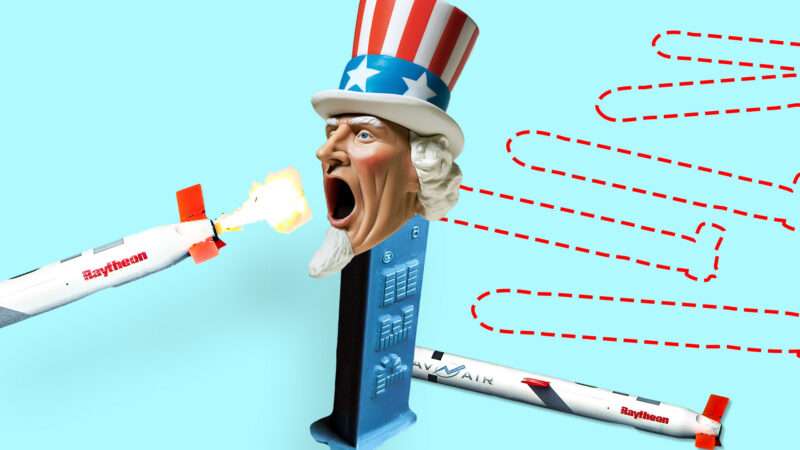
Does the U.S. government have enough ammunition for all its wars and potential wars? Ask two different Pentagon officials and get two different answers.
In May 2026, acting Navy Secretary Hung Cao told Congress that "we're doing a pause" on sales to Taiwan "in order to make sure we have the munitions we need" for the Iran war. A few days later, Defense Secretary Pete Hegseth backpedaled. "Hung Cao is fantastic, but I would not couple the two in any way at all," he told reporters. "And I feel good about not only where we are, but where we are in future production rates as well." It was the latest in a series of statements from Hegseth and other Trump administration officials complaining that the media were exaggerating munitions shortages.
The lady doth protest too much. Warning lights have been blinking for years about the United States' ability to prepare for future conflicts while also supporting proxy wars in Europe and the Middle East. The direct war with Iran burned through U.S. magazines at an even faster pace.
"The U.S. has stockpile requirements that reflect contingency plan requirements. Of course, it accepts some risk when it needs to," explains Josh Paul, previously the State Department official in charge of weapons sales. In other words, the question of how much ammunition is enough is a question of acceptable danger.
The current shortages are especially dire when it comes to air defense ammunition. That introduces a kind of danger that the U.S. and its partners simply aren't used to. After generations of U.S. aerial dominance, the economics of war are exposing American troops—and First World societies—to being bombed from above.
The main round of U.S.-Iranian fighting ended in April 2026 with 14 Americans dead and 409 wounded. There are signs that the situation would have gotten dramatically worse if it had continued. Just before the ceasefire, Iran was achieving an increasing hit rate with smaller barrages because the U.S. and its partners had used up so much of their air defense ammunition. Israel was rationing its high-end missile interceptors, whose numbers had fallen to "double digits," a U.S. source told Drop Site.
Future U.S. wars may look "more like Ukraine," with heavy bombing on both sides, says Justin Logan, director of defense and foreign policy studies at the libertarian Cato Institute. "The Americans like to insulate ourselves and our friends from adversaries' ability to retaliate, but that's extremely costly."
Shortages are already being felt in Ukraine itself. After a June 2026 air raid by Russia killed 22 people, Ukrainian President Volodymyr Zelenskyy pleaded with European allies to speed up deliveries of the American-made Patriot air defense system, adding that the issue was "no longer about financing." There just wasn't enough inventory to go around. The Ukrainian government proposed "borrowing" Patriot ammunition from Germany, emptying German warehouses in exchange for an IOU.
Meanwhile, Taiwan is waiting for the Trump administration to approve a $14 billion arms sale that Congress has already signed off on. Part of the holdup seems to be political; President Donald Trump told Fox News the delay was "a very good negotiating chip for us" against China and a way to get both sides to "cool down." But shortages are another part of the calculation, as Cao admitted. Reuters reports that the deal, whose contents have not been publicly reported, "largely consists" of Patriot ammunition and other air defense weapons.
"Everybody wants to adopt the American way of war, but nobody can afford it, including the Americans," Logan says. "The ability to sustain political support drops like a lead balloon when we can't intercept retaliation."
How Drones and Cheap Missiles Ended America's Free Pass From Enemy Fire
For most of the last century, the United States has gotten used to fighting one-sided air wars. Before the recent Middle Eastern conflicts, U.S. troops were last killed by hostile aircraft during the Korean War in 1953. In recent years, the feeling grew that the U.S. military could simply bomb other countries with no real cost. The public took little notice as the Obama, Biden, and Trump administrations waged "light footprint" air campaigns around the world.
"It works for a time, when you have this enormous asymmetry, but adversaries of all kinds learn to adapt," says Kelly Grieco, a fellow at the Stimson Center. "There were warning signs long before this war."
One important change was the drone revolution. Advances in electronics allowed small countries to get in on the game by the dawn of the 21st century. Israel became a leader in drone technology, which Turkey purchased and Iran stole. Chinese hobby drones hit the civilian market in the early 2010s, making this type of warfare even cheaper. The Islamic State group obtained a small "air force" by strapping grenades to photography drones.
When the U.S. fought the Islamic State in 2014's Battle of Mosul, a U.S. Army colonel told Grieco that it was the first time that he "ever had to look to the sky and be concerned about the enemy."
Meanwhile, Iran took lessons from Iraq, which had invaded Iran in 1980 and in turn suffered a U.S. invasion in 2003. The Iranian government concluded that it couldn't build a competitive air force—but it could produce overwhelming numbers of ground-based missiles domestically.
The final turning point for the old model of war may have come during a conflict most Americans haven't heard of: the 2020 war between Azerbaijan and Armenia. Azerbaijani forces debuted the use of Israeli "kamikaze drones," which fly themselves into a target and explode, alongside conventional Turkish drones. Two years later, when Russia invaded Ukraine, the Ukrainian army invested in those same Turkish drones, while the Russian military imported Iranian experts and designs to mass-produce the Shahed 136 kamikaze drone.
As the war in Ukraine dragged on, each side adopted the Islamic State tactic of using hobby drones to drop grenades on individual soldiers. When radio jamming made drone attacks harder, the armies then equipped their drones with spools of fiber-optic cable. Battlefields have become littered with miles of discarded wires. Beyond the front lines, Russia and Ukraine have been using long-range drones to bomb each other's infrastructure and drone fighters to shoot down (or stab down) those drone bombers.
The United States and its Middle East partners were used to a higher level of protection than Russia or Ukraine found possible to achieve. Israel's Iron Dome, an air defense system for short-range rockets and artillery, had a reported 90 percent interception rate in small wars from 2011 to 2023. The oil-rich Arab monarchies were even more casualty-averse. When Yemeni rebels drone-bombed Saudi Arabia in 2019 and the United Arab Emirates in 2022, both air raids caused a national crisis.
This year's war with Iran unleashed the first sustained air attack those countries faced from someone more sophisticated than ragtag guerrillas. They tried to maintain the previous level of insulation at a massive cost. Ukrainian military advisers told the The Times of London they were "astonished" to see Arab militaries firing off eight Patriot interceptors to shoot down a single Iranian drone. Israel used up 80 percent of its entire stockpile of high-end Arrow interceptors in 16 days, according to a study by the Royal United Services Institute (RUSI) in Britain. On top of that, the U.S. military fired more interceptors in Israel's defense than the Israeli army itself did, according to The Washington Post.
The Israeli and U.S. militaries also burned through their offensive weapons, according to RUSI. Hegseth warned Japan that the U.S. no longer had enough Tomahawk cruise missiles to spare, the Financial Times reported. When it runs low on these "standoff munitions," which allow U.S. aircraft to fire from a distance, the U.S. has "to fight closer in, and when you fight closer in, there's greater risk," Grieco says.
Part of the U.S. problem with Iran seems to have been the assumption of a quick victory. Trump said both publicly and privately that he expected Iran to fold within days. At the beginning of the war, the U.S. military touted its ability to proactively suppress Iranian missile fire in the immediate term by blowing up launcher trucks or caving in underground base entrances. But the launchers were simple to replace—they're just normal trucks with some extra hydraulics, after all—and caved-in base entrances could be dug out.
The worst-case near-future scenario for the U.S. military, a war with China in the Pacific, would combine all of these issues with several new ones. U.S. allies Japan, South Korea, and Taiwan are all high-tech economies within range of Chinese and North Korean missiles. China has much more formidable air defenses than Iran, making missile suppression almost impossible. And because Taiwan is an island that is easy to isolate, all of its defense weapons would have to be imported before a crisis starts.
In January 2023, the Center for Strategic and International Studies (CSIS) ran a war game simulating a Pacific war caused by a Chinese invasion of Taiwan. The simulation found that the U.S. military would run out of Long Range Anti-Ship Missiles (LRASM) within days and Joint Air-to-Surface Standoff Missiles (JASSMs) within two to three weeks. The center concluded that the U.S. could defeat an invasion of Taiwan, but at a cost of hundreds of aircraft—and more human casualties in a month than Americans had suffered over the past generation of wars combined.
Why the Pentagon Can't Just Build Its Way Out of the Ammo Crisis
After three years of European and Middle Eastern fighting, the munitions situation is now significantly worse. The U.S. military used up about 25 percent of its JASSMs in the Iran war, according to the RUSI study. A separate CSIS study from May 2026 found that rebuilding those missiles could take until mid-2027; it would take another two years to bring various air defense magazines back to prewar levels, and it would be the 2030s before Washington could replace all the Tomahawk cruise missiles used in the war.
The Pentagon wants to pour gargantuan amounts of money into doing so. The military budget request for fiscal year 2027, a historic $1.5 trillion, includes $52 billion for high-priority munitions—nearly a fivefold increase over the previous year—and another $100 billion to build up the industrial base. On top of the annual military budget, the Trump administration also planned to ask Congress for $200 billion for supplemental Iran war funding, though the administration later shrunk that request and folded much of it into the annual military budget, The Washington Post reports.
A closer look at the budget request shows how unbalanced the math of air defense is. The latest model of Patriot interceptor, the PAC-3, will cost approximately $4 million per unit. (Remember, Arab armies were firing up to eight of them against a single drone.) While the cost of the Shahed 136 is not public knowledge, an Iranian source told the American economics magazine Phenomenal World that each drone costs 6 billion rials, which came out to $4,000 on the most up-to-date exchange rate.
Even more important than the dollar price are the resources and time each weapon takes. Adjusting for the local cost of parts and labor, Phenomenal World calculated that the real equivalent price of a Shahed 136 would be around $7,000 per drone, still much lower than the interceptor used to shoot it down. While a single Shahed factory in Russia can make 5,500 drones per month, the total production of PAC-3s is currently less than 1,000 per year. In the two-year journey of a PAC-3 from order to delivery, new workers must be trained in specialized skills and vetted for security clearances; manufacturer Lockheed Martin has to source parts from more than 400 companies.
The PAC-3 is often competing with other weapons for the same components—and these components compete with other industries and other countries for raw materials. In April 2025, the Chinese government imposed strict export controls on rare earth minerals and permanent magnets, sending the Pentagon on a frantic and expensive quest to identify new sources, according to the CSIS.
Investments can increase production. The United States and its allies have been fairly successful at pumping out more 155mm artillery shells, one of the chief concerns two years ago. But the process of expanding production itself takes years. Lockheed Martin is planning to increase its annual production of the PAC-3s to around 2,000 by fiscal year 2030.
The long time for these investments to pay off is a structural barrier. "The challenge has always been the private sector's willingness to reinvest profits in production," says Paul, the former State Department official. "For instance, if you're a publicly traded company, would you rather have a full 10-year book, or spend a chunk of your own capital to build a new production facility, reducing your book to 5 years, for a system that may be outdated in 10 years?"
Despite these problems, the United States is still the world's largest supplier of arms. Its share of the global market has actually grown since 2016, according to the Stockholm International Peace Research Institute in Sweden. When journalists ask her whether the United States has sufficient munitions, Grieco always responds, "Sufficient munitions to do what? Because no country other than maybe China has the kind of depth that we do in munitions."
Ultimately, the issue with munitions is less a shortage of supply and more an excess of demand. The United States wants to be involved in conflicts around the world while retaining the ability to start new ones, such as the Iran war. At the same time, societies like ours "are built on assuming away the prospect of punishment" in war, Logan says.
That's not sustainable anymore, thanks to advances in missile and drone technology. "Warfare is about larger numbers of smaller, cheaper, plentiful things that strongly favor the defense," Grieco explains. Ironically, the abundance of offensive weapons means that the defender can punish the attacker more easily.
Rather than trying to fight this trend, the United States can stop putting itself in the position of an attacker. Washington's chief stated foreign policy goals outside the Middle East are repelling an invasion of Ukraine and deterring an invasion of Taiwan. If the U.S. can resist the temptation to launch more wars, then the technological changes "ought to be good news," Grieco argues. "We should be leveraging this defensive potential."
The post America Spent a Fortune Shooting Down Cheap Drones. Now the Missile Stores Are Bare. appeared first on Reason.com.
FIP XML/RSS/RDF Newsfeed Syndication https://freeinternetpress.com/rss.php
© 2026 FreeInternetPress.com
Free Internet Press is licensed under a Creative Commons Attribution 3.0 United States License. You may reuse or distribute original works on this site, with attribution per the above license. Any mirrored or quoted materials may be copyright their respective authors, publications, or outlets, as shown on their publication, indicated by the link in the news story. Such works are used under the fair use doctrine of United States copyright law. Should any materials be found overused or objectionable to the copyright holder, notification should be sent to [email protected], and the work will be removed and replaced with such notification.
Please email [email protected] with any questions.