

Trump's $100,000 H-1B Visa Fee Is an Unconstitutional Tax, a Federal Judge Rules
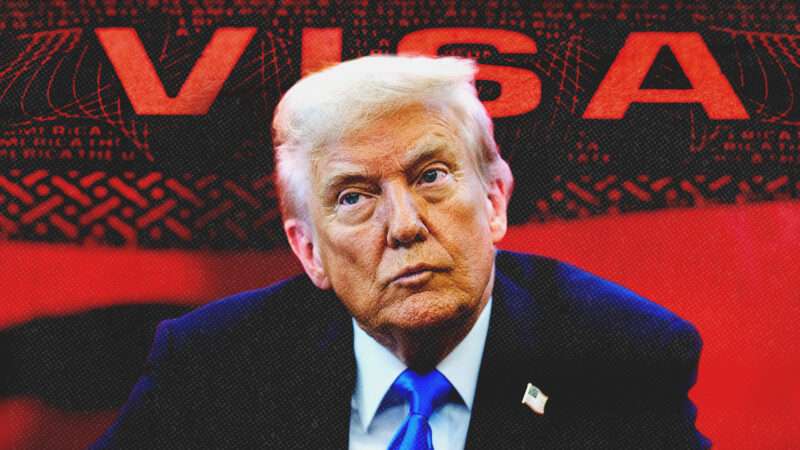
President Donald Trump violated the separation of powers when he announced a new $100,000 fee for H-1B visa applications last September, a federal judge in Boston ruled on Monday. Trump's policy "imposes a tax on H-1B petitions without the requisite delegation by Congress," wrote U.S. District Judge Leo Sorokin, a Barack Obama appointee. He also concluded that the policy violated the Administrative Procedure Act because it exceeded the president's statutory authority and was implemented in an "arbitrary and capricious" manner.
Sorokin's decision, which completely vacates the visa fee, contrasts with a December 23 ruling by a federal judge in Washington, D.C. Beryl Howell, also an Obama appointee, thought the visa fee was justified by "a straightforward reading of congressional statutes giving the President broad authority to regulate entry into the United States."
Sorokin was responding to a lawsuit by California and 19 other states, while Howell was assessing claims by the U.S. Chamber of Commerce. Unsurprisingly, the disagreement between the two judges hinges mainly on statutory interpretation. But it also involves a constitutional question: whether Trump's visa fee usurped the tax power that Article I assigns to Congress.
In 1990, Congress amended the Immigration and Nationality Act (INA) to create the H-1B program, which is designed to accommodate employers who want to hire foreign workers for jobs requiring "theoretical and practical application of a body of highly specialized knowledge." The workers must have at least a bachelor's degree (or the equivalent) in a relevant field. H-1B visas are capped at 85,000 a year, and employers previously could expect to pay fees up to $5,000 for each one.
That changed in September, when Trump issued a proclamation that prohibited entry under H-1B visas "except for those aliens whose petitions are accompanied or supplemented by a payment of $100,000." He presented that fee, which he said would be in effect for a year "absent extension," as a response to abuse of the program, which he said "has been deliberately exploited to replace, rather than supplement, American workers with lower-paid, lower-skilled labor."
Trump averred that "the large-scale replacement of American workers through systemic abuse of the program has undermined both our economic and national security." Allowing employers to hire high-skilled foreign workers without shelling out $100,000 for the privilege, he declared, "would be detrimental to the interests of the United States because such entry would harm American workers, including by undercutting their wages." The proclamation authorized the secretary of homeland security to make exceptions he determines are "in the national interest."
As Howell saw it, that new policy fit comfortably within "the executive's broad authority under the INA." The main INA provision on which Trump relied, 8 USC 1182(f), says: "Whenever the President finds that the entry of any aliens or of any class of aliens into the United States would be detrimental to the interests of the United States, he may by proclamation, and for such period as he shall deem necessary, suspend the entry of all aliens or any class of aliens as immigrants or nonimmigrants, or impose on the entry of aliens any restrictions he may deem to be appropriate." Another provision, 8 USC 1185(a)(1), authorizes the president to issue "reasonable rules, regulations, and orders" regarding the entry and removal of aliens.
The interaction between those two provisions, Howell said, "illuminates the full breadth of the authority handed to the President over time by Congress to regulate entry into the United States." Whether interpreted as a "restriction" under Section 1182(f) or a "regulation" under Section 1185(a)(1), she concluded, the new requirement for H-1B visas was clearly authorized by the INA.
Howell rejected the argument that the new visa fee amounts to an unauthorized tax. "The Taxing Clause does not impose on Congress a heightened requirement to make a valid delegation to the President, and Congress was clear in its delegation," she wrote. "Section 1182(f) uses exceeding[ly] broad language, including that the regulation might occur 'for such period as he shall deem necessary' and may entail 'any restrictions he may deem to be appropriate.'" That language, she said, "is sufficiently broad to encompass a regulation requiring an additional payment obligation for entry of a nonimmigrant H-1B visa worker."
Howell acknowledged the Chamber of Commerce's complaint that the $100,000 fee "would inflict significant harm on American businesses and institutions of higher education, which would be forced to either dramatically increase their labor costs or hire fewer highly skilled employees for whom domestic replacements are not readily available." She said there was also "some force" to the trade group's argument that Trump failed to consider that "these harms to American businesses and higher education will also be a boon to America's economic rivals, who will surely welcome the talent no longer able to accept work in the United States." But she noted that "the relevant analysis focuses on constitutional and statutory powers, not economic policy."
Sorokin applied the same analysis but came to dramatically different conclusions. The relevant Supreme Court precedents support "a finding that the $100,000 payment requirement amounts to a tax, not a penalty," he wrote. And last February in Learning Resources v. Trump, he noted, the Court held that the International Emergency Economic Powers Act (IEEPA) did not authorize Trump to impose tariffs, rejecting his argument that the power to "regulate…importation" included the power to tax imports.
The INA provisions cited by Trump "allow the President to impose 'restrictions,' 'rules,' 'regulations,' 'orders,' 'limitations,' and 'exceptions' to the entry of noncitizens to the United States," Sorokin noted. "Like the powers delineated in the IEEPA, none of
these terms, by their ordinary meaning, include the power to tax."
Although Section 1182(f) "arguably contains sweeping, discretion-conferring language," Sorokin said, "Defendants point to no other provision in the INA or elsewhere making it clear that Congress intended to delegate the taxing power." He added that "Defendants' miscellaneous arguments that the President has the authority to impose the $100,000 tax based on his 'immigration and commerce powers' are nowhere to be found in the authorities they cite."
Sorokin acknowledged that Trump's proclamation "can be understood as creating an entry restriction—a type of measure that Congress committed to the President's discretion." But that appearance is deceptive, he said, because "the Proclamation's payment requirement amounts to a tax, which exceeds the scope of the President's discretionary authority under the INA."
The INA allows the Department of Homeland Security to charge "adjudication fees" that "may be set at a level that will ensure recovery of the full costs of providing all such services" and of "any additional costs associated with the administration of the fees collected," Sorokin noted. "The $100,000 payment requirement plainly does not constitute an adjudication fee under this statutory provision. As Defendants concede, the Proclamation 'does not impose a fee to cover costs, does not displace that fee, and is not collected or used in the same manner.' Defendants point to no other statute empowering agencies to impose a tax on H-1B petitions."
The Administrative Procedure Act instructs courts to "set aside" agency actions that are contrary to law. Accordingly, Sorokin's order vacates "the Policy materials" implementing the $100,000 fee.
Trump was not pleased. "These federal judges are really giving us a hard time," he complained on Tuesday. "It is really crazy what's going on with the court system."
The Trump administration presumably will ask the U.S. Court of Appeals for the 1st Circuit to review Sorokin's decision. Meanwhile, the Chamber of Commerce is asking the U.S. Court of Appeals for the D.C. Circuit to reverse Howell's contrary ruling.
The post Trump's $100,000 H-1B Visa Fee Is an Unconstitutional Tax, a Federal Judge Rules appeared first on Reason.com.
FIP XML/RSS/RDF Newsfeed Syndication https://freeinternetpress.com/rss.php
© 2026 FreeInternetPress.com
Free Internet Press is licensed under a Creative Commons Attribution 3.0 United States License. You may reuse or distribute original works on this site, with attribution per the above license. Any mirrored or quoted materials may be copyright their respective authors, publications, or outlets, as shown on their publication, indicated by the link in the news story. Such works are used under the fair use doctrine of United States copyright law. Should any materials be found overused or objectionable to the copyright holder, notification should be sent to [email protected], and the work will be removed and replaced with such notification.
Please email [email protected] with any questions.